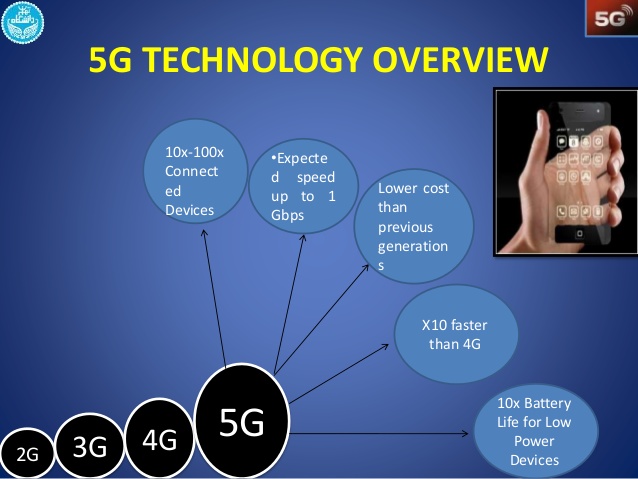
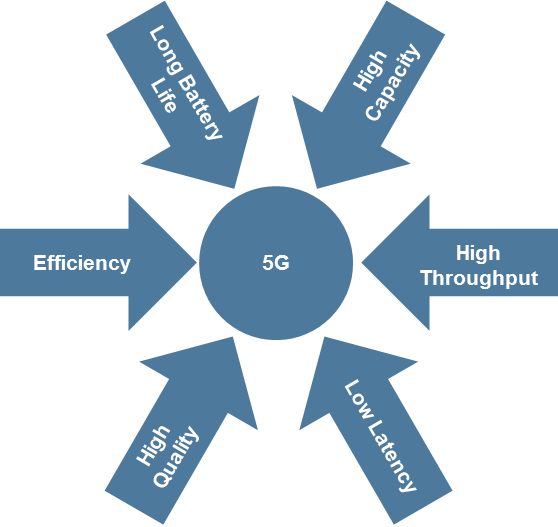
There is a strong tendency to override 5G, said Vodafone CTO Johan Wibergh at the Huawei Global Mobile Broadband Forum (HWMBBF) in London. The expectations of 5G are partially too big, on the other hand, many applications could also be implemented with LTE. He recalled that mobile phone generations are usually around 10 years up to date you can not say what will be possible in 2030 with 5G. Wibergh made a clear statement about UMTS: the 3G mobile phone network of Vodafone should be shut down in Europe from 2020.
4G Evolution and 5G New Radio
Many features that are currently often attributed to the next generation 5G mobile phones are easily possible with LTE, according to Vodafone CTO Wibergh. Gigabit speeds, very low latency times and IoT are easily possible with the latest LTE Advanced Pro (4.5G) networks. This is achieved by technologies such as 256QAM modulation, Massive MIMO antenna technology and bundling frequency ranges via carrier aggregation. Nevertheless, 5G offers tangible advantages, of course: with additional radio spectrum (“New Radio”), first in the range around 3.5 GHz, extremely high bandwidths become possible, for example. According to Wibergh, 5G is also about 10 times more cost-efficient than LTE.
UMTS will be switched off from 2020
A very interesting statement made by Vodafone CTO Wibergh on the topic of UMTS: the 3rd mobile generation should be switched off gradually in Europe from 2020, even before GSM/2G. The radio spectrum can be used much more efficiently with LTE or 5G.
The shutdown of 3G is unlikely to be noticeable to users, on the contrary, the transition to new technologies will be fluid. Vodafone uses its previously used exclusively spectrum in the range of 2100 megahertz for UMTS frequency, partly for LTE. This is likely to be the case more often in the future, as long as Vodafone acquires spectrum in the 2100 MHz range at the next frequency auction.
The development of the next mobile communication standard 5G is progressing. Now it becomes clear that the frequency range of around 3.5 gigahertz will be the basis for 5G mobile networks worldwide. Confirmed Eros Spadotto from Canadian provider TELUS at the Huawei Global Mobile Broadband Forum in London. Even the network outfitter Huawei pleads for this frequency range in a position paper, summarizes it at 3.3 to 4.2 GHz but something further. Frequency spectrum in the range between 3.4 GHz and 3.8 GHz will be awarded in 2018 in many European countries, including a corresponding frequency auction is planned in Germany. In Canada, according to TELUS, an auction is expected in 2019.
5G Network Frequency: 3.5 GHz to start
The frequency range around 3.5 GHz will be available worldwide in many countries for mobile phone use. However, the area is not exactly defined yet, in most countries preparations are currently underway for the allocation of frequencies to the mobile network operators and the exact “limits” of the auctioned radio spectrum are not yet known. Huawei speaks in its position paper from the C-band, more specifically between 3.3 to 4.2 and 4.4 to 5.0 GHz. In order to expand 5G networks in a timely manner, the core range between 3.3 and 3.8 gigahertz is important, according to Huawei, and should be made available to network providers as quickly as possible.
Some carriers in Europe uses the frequency range of 3.7 GHz in its 5G test network in Berlin, where it reaches speeds of 2 GBit/s, and the range is around 400 meters. The network provider expects the launch of the first 5G networks in exactly this frequency range, more specifically between 3.5 GHz and 3.9 GHz .
5G: more frequency ranges later
Although the range around 3.5 GHz will probably be used in many countries worldwide as a “base band” for 5G: significantly more radio spectrum is needed to achieve the need for bandwidth on the one hand and very good network coverage on the other. Huawei proposes three different “layers” in its position paper: the 3.5 GHz band should be sufficient as a “coverage and capacity layer” for most applications. On the other hand, very high speeds will demand significantly more radio spectrum, which will then be made available in the “Super Data Laye ” – probably in the cmWave range around 28 gigahertz. Bruno Jacobfeuerborn, head of technology at Germany Telekom, assumes that at the start of 5G in the year 2020, this “super data layer” is not available, but only later expanded.
The third very important part in the 5G frequency spectrum is the so-called “Coverage Layer“. So the area with which a huge network coverage can be achieved. It does not depend on extremely high data rates, but on the fact that a basic supply of 5G can be made available almost everywhere. Huawei proposes in its position paper for the “Coverage Layer” the frequency range below 2 GHz, which is currently used by GSM, UMTS and LTE. It is conceivable, therefore, that the network operators integrated the existing LTE networks into their 5G networks, making LTE an integral part of 5G. According to Eros Spadotto, the Canadian provider TELUS assumes that the frequency range around 600 MHz will be used in North America for the “Coverage Layer” of 5G. In Europe, the area around 700 MHz is more likely to be used for this purpose.
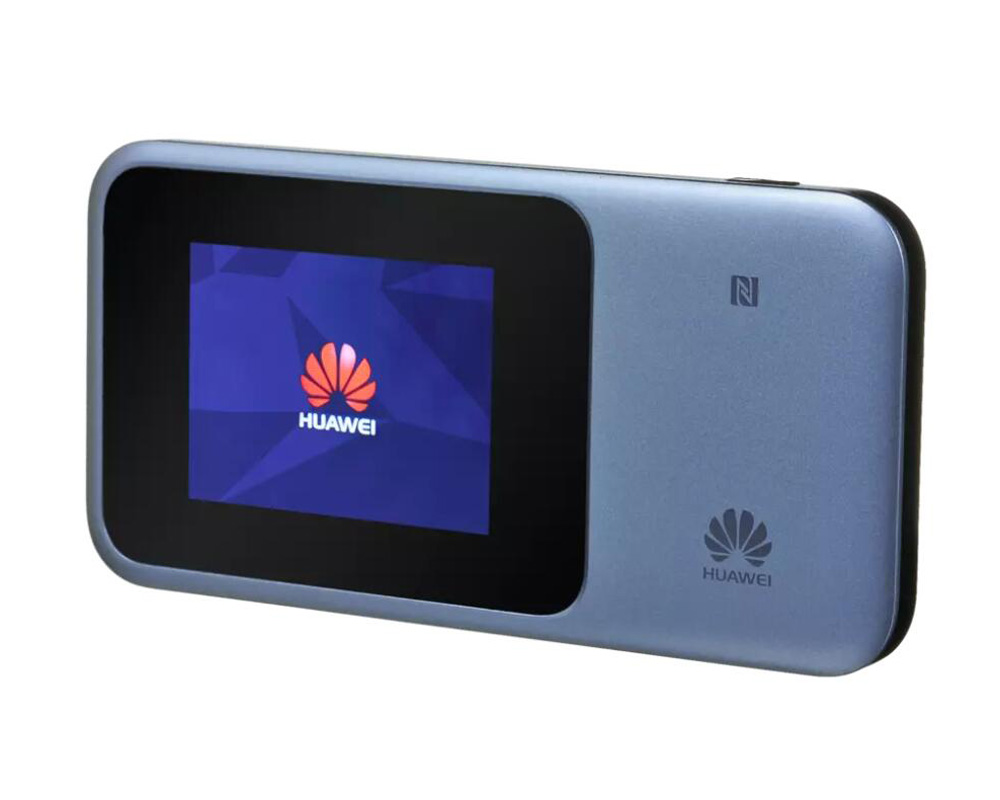
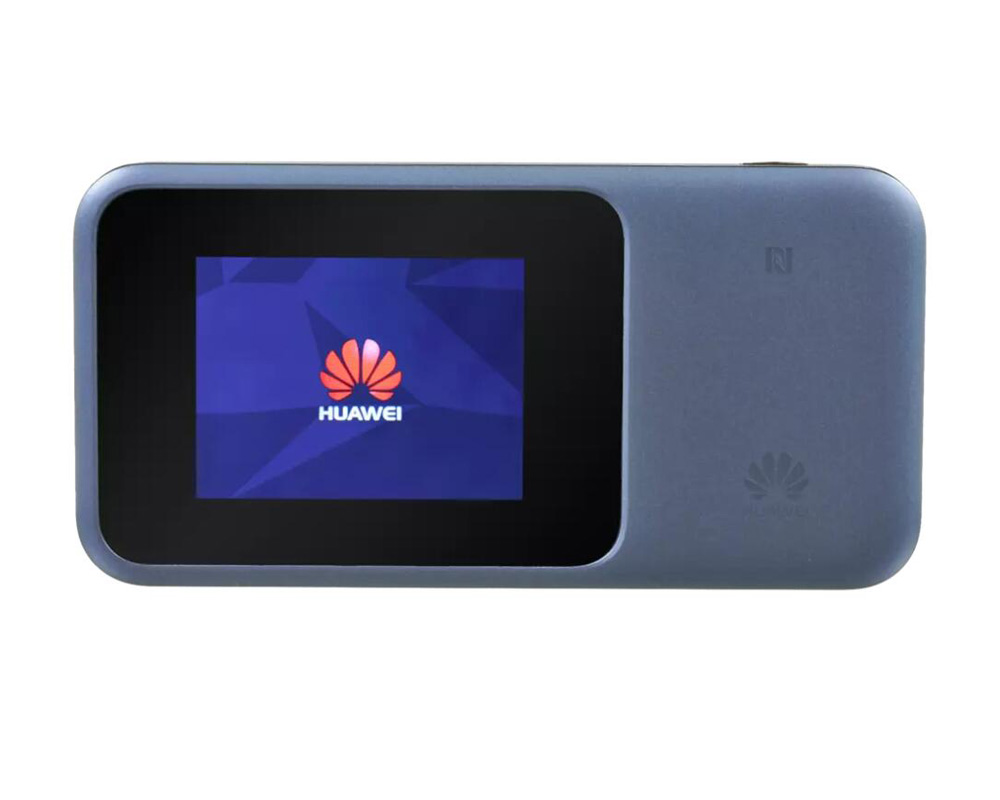
A mobile wireless router named “Huawei E5788u-96a” from Chinese manufacturer Huawei Technologies (Huawei Technology) was released. According to the official sayings, it’s the world’s first LTE category 16 mobile hotspot with support of peak download speed up to 1Gbps(Gigabit Per Second). As the first Cat.16 Gigabit hotspot, it will improve access to high-quality video streaming, and facilitate emerging mobile virtual reality applications and experiences, and is a key step towards 5G.
With the advanced Qualcomm MDM9250 chipset using 6 LTE antennas design, Huawei E5788 MiFi could support full-band 4 x 4 MIMO, four carrier aggregation (4CC) and leading DL 256QAM modulation to download data at up to 1 Gbps as well as 64QAM and 2CA to upload data at up to 150 Mbps. It enables you to open online 4K HD movie in seconds. Comparing the predecessor Huawei E5786, the Huawei E5788u-96a could covers more 4G/LTE/3G frequency bands as below:
It should be emphasized that the Huawei E5788u-96a could support TD-LTE band 42(3500MHz). In the market, there are very few mobile terminals that support this band. As we know, there is only the Huawei E5776s-420 mobile 4G Router for band 42.
The display of Huawei E5788 has a color liquid crystal of about 2.4 inches and can be operated with a touch panel. Huawei E5788u-96a also supports Bluetooth 4.1 and Wireless LAN IEEE 802.11 a/b/g/n/ac (2.4 GHz and 5. x GHz Dual-Band). It is possible to connect 32 wireless LAN devices simultaneously. The battery of Huawei E5788 can keep working up to 10 hours! The Bluetooth data transmit and wake up function means users can access the internet through Bluetooth connection and save 40% battery life compared to Wi-Fi connection, extending the device power and standby time. It is also compatible with NFC, and by connecting a smartphone or the like compatible with NFC, it is easy to connect.
Currently, there is only the Netgear Nighthawk M1 which has similar specifications and could be a competitor to Huawei E5788u-96a, but according to the predecessor Huawei 4G mobile hotspots, we believe Huawei E5788 would be a new hot selling star. And we would take detail test on this new Gigabit mobile hotspot in near future.
In this article I would like to explain the concept or the technology carrier aggregation in connection with LTE. Carrier aggregation, in short CA , is an important component of the 3GPP release 10, and thus of LTE-Advanced ( LTE-A ), which was specified in 3GPP Release 10. LTE-A consists of several components, including CA, for example 8 × 8 MIMO, and LTE UE categories 6, 7 and 8.
In addition to a higher speed (up to about 1.2 gigabits per second downstream in LTE cat. 8 UE) compared to normal LTE, improved data rates on the cell edge are also a plus for LTE-A. However, in spite of various optimizations, one will need more frequency spectrum in the future in order to be able to further increase the data rates and meet the increase in global traffic – the peak data rates of LTE-A can only be achieved if up to 100 MHz are bundled. And this is where Carrier Aggregation is used.
Problem: Frequency spectrum is a scarce resource
The topic affects almost all mobile network operators in the world: they do not have enough coherent frequency spectrum to easily offer the high data rates of LTE-A. In Germany, for example, there is only 20 MHz bandwidth available in the frequency range around 800 MHz – paired in 4 blocks, ie 10 MHz for the downlink and 10 MHz for the uplink. In the configuration currently in use (2 × 2 MIMO, LTE UE Cat. 3), a maximum of 75 MBit/s can be reached in the downstream, although not much more than 60 MBit/s is possible.
Fortunately, the providers in Germany have enough spectrum to be able to connect at least LTE cat. 4 with up to 150 MBit/s without much effort, at least in the frequency ranges around 1800 MHz and 2600 MHz. It is only more difficult if higher speeds are desired. In other countries, such as South Korea, for example, there is already this problem, where carrier aggregation is used. Before I get to the details of this technology, first a short video from the company Qualcomm, which explains the functionality in a quite appealing way:
Carrier aggregation: bundling of different frequency
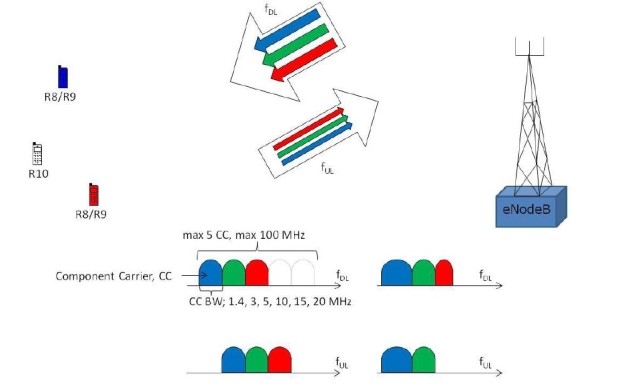
Blocks with CA, the network operators are able to bundle different frequency blocks into a large block for the first time. After 3GPP release 10, the upper limit is at 100 MHz, although a later expansion is of course not excluded. In the medium term, however, it is likely to be a bundling of 40 to 60 MHz.
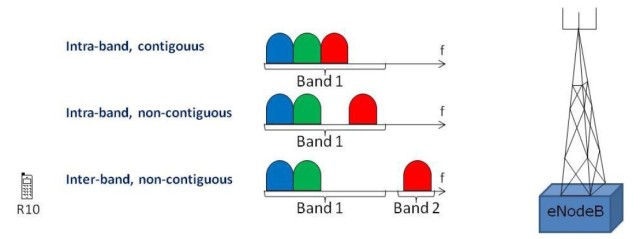
There are three different modes for channel bundling, whereby only the following carriers can be combined: 1.4 / 3/5/10/15/20 Megahertz. How and in what way the combination takes place is left to the network operator, but maximum of 5 carriers can be bundled:
Intra band, contiguous:this is the simplest CA method. Two or more frequency blocks are clustered, contiguous and within a frequency range (Intra band). So, for example, 2x 10 MHz in band 3 (frequency range around 1800 MHz). The terminal does not need any great hardware changes because it perceives the aggregated channel as a large channel and therefore requires only one transceiver (transceiver).
Intra band, non-contiguous: in this method, two or more carriers are bundled, these frequency blocks being not adjacent but lying in the same frequency range. On the end of the terminal, two or more transceivers are now required to use the aggregated band.
Inter-band, non-contiguous: this CA method is likely to be the most widely used in the future as it is most likely to be true for network operators. In this case, frequency blocks from different frequency ranges can be bundled in order to create the largest possible frequency block. A possible scenario would be, for example, the combination of spectrum from band 20 (around 800 MHz) with spectrum from band 3 (1800 MHz). As you can imagine, several transceivers and further optimizations are necessary in the terminal, which can have a noticeable effect on the energy consumption.
Different ranges of individual carriers and downwards compatibility
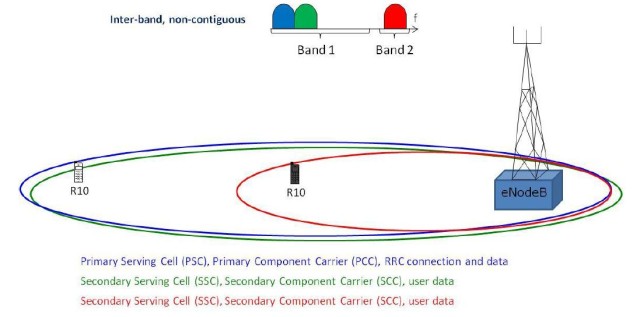
Especially in the case of carrier aggregation using inter-band, non-contiguous, it is inevitable that there will be differences in the size of the individual cells. Thus, with a terminal with CA support close to an LTE transmitter (eNodeB), very high speeds will be achieved as the terminal can use a lot of bundled spectrum. A few kilometers from the transmitter is possibly only LTE800 receivable and CA brings no more advantage.
As can be seen in the above, there is always a Primary Serving Cell, or PCC, a “main cell”, which ensures the supply. The other cells (SCC) serve merely as a support for user data, in other words to increase the bandwidth. Depending on the terminal, the PCC can be different, depending on various factors, for example the respective energy consumption in the terminal. This, of course, requires a lot of optimization both in the network planning and in the manufacturers of the modems for mobile devices.
Of course, CA and thus also LTE-A is down-compatible with “conventional” LTE. Old and currently available terminals are therefore still usable in the future. Nevertheless, if you want to use the higher bandwidths or carrier aggregation, you obviously need a new terminal. Here, again, the LTE UE category has to be considered, CA alone is not enough to achieve speeds in the gigabit range.
It’s a long time since the Huawei B618 4G Router was firstly released by the manufacturer Huawei. Some information shows the Huawei B618 4G LTE Router was already available in some network providers’ data plan. Good news is that we get the unlocked Huawei B618 4G Router now.
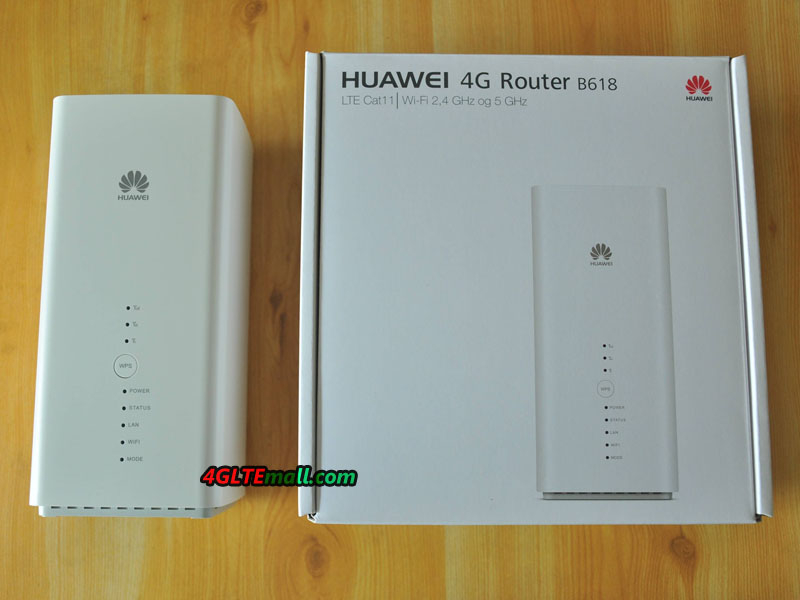
The Huawei B618 Router is packed in white box with the image of B618 printed on the front with the model number. The device is in white color and looks good. Protected by a plastic bag, the Huawei B618 is unlike usual wireless router shaped in a cube, so it’s also called Huawei B618 Cube. When it stands on the desk, it looks like a humidifier.
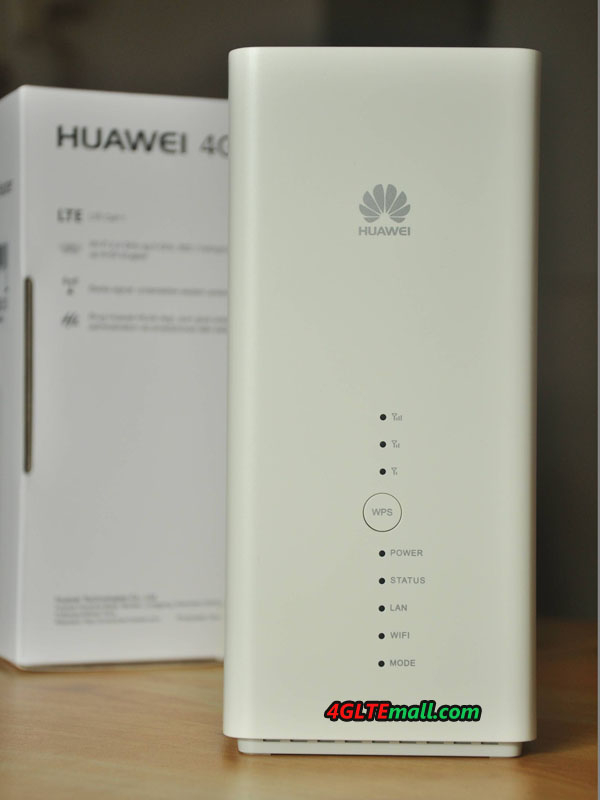
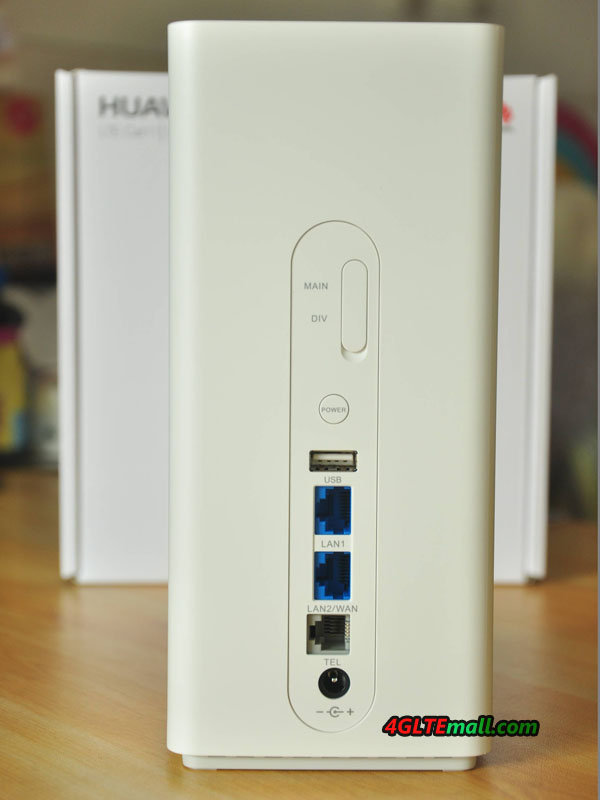
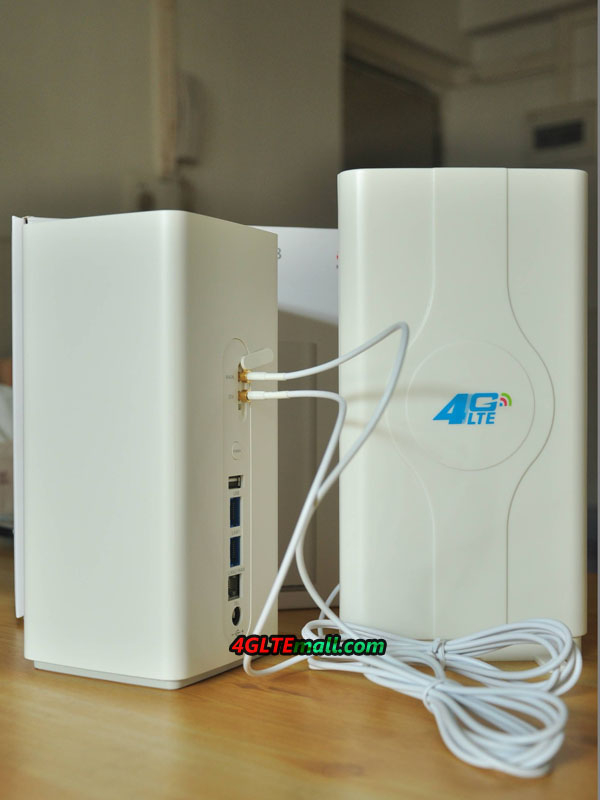
On the front, we can see the Huawei logo and below is are the LED indicators including three signal bars, WPS button, Power indicator, Internet Status indicator, LAN status indicator, WiFi indicator and Mode indicator. On the back, we can see the power button, one USB2.0 port, One LAN port and one LAN/WAN port, one telephone port and power adapter plug port. At the top are the two connectors for external antenna covered by a small cap.
The connector type of the Huawei B618 external antenna is TS-9 and we had tried the antenna with two TS-9 connectors with the Huawei B618 Router. They are working together very well.
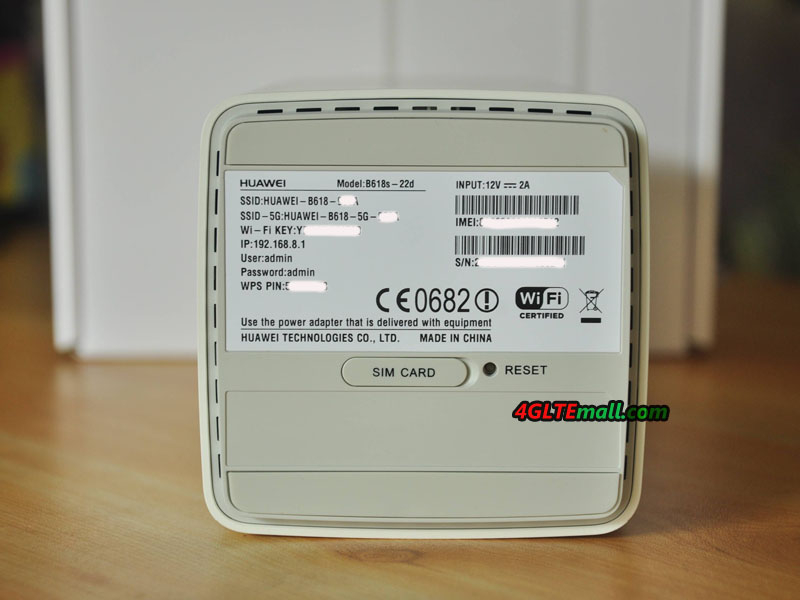
Like its predecessor Huawei E5180s-22 Cube, there is a label at the bottom of the device, which would show more details about this device. We can see it indicates the model number is B618s-22d. Below the model number, there are SSID name, SSID 5G name, WiFi key/password, IP address for web management, user name and password for log in web IP address, and the WPS Pin code.
On the right side, it indicates the input power is 12V-2A, and the IMEI number & S/N are listed with the bar code. The CE0682, RoHS and WiFi certified with the Made in China and Huawei Technologies Co., LTD are also on the label. Below the label is the SIM card slot, which is also covered by a cap to protect from dust. User needs to open the cap and plug in the sim card. At the SIM card slot side, it’s the rest hole. If you want to reset the router, you need press the reset button the hole for few seconds.
Here now the original new and unlocked Huawei B618s-22d is available on www.4gltemall.com, if you are looking for a cool 4G wireless router supporting LTE-Advanced networks, Huawei B618 Cube should be a good option.
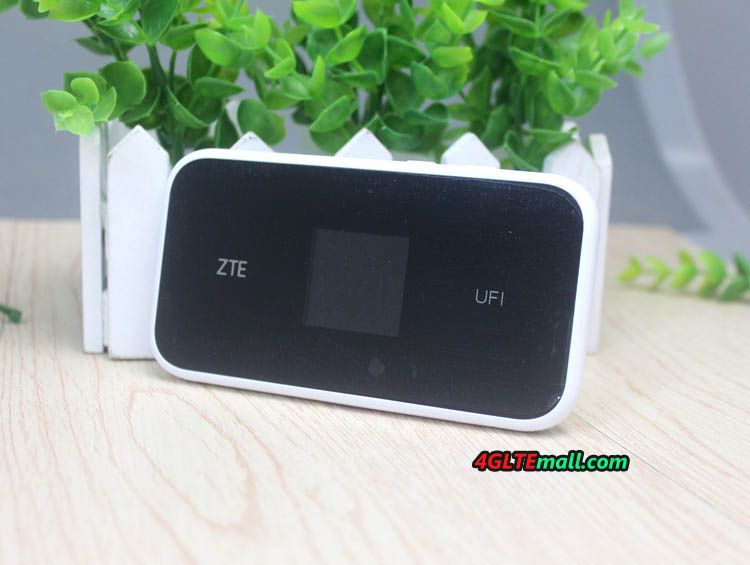
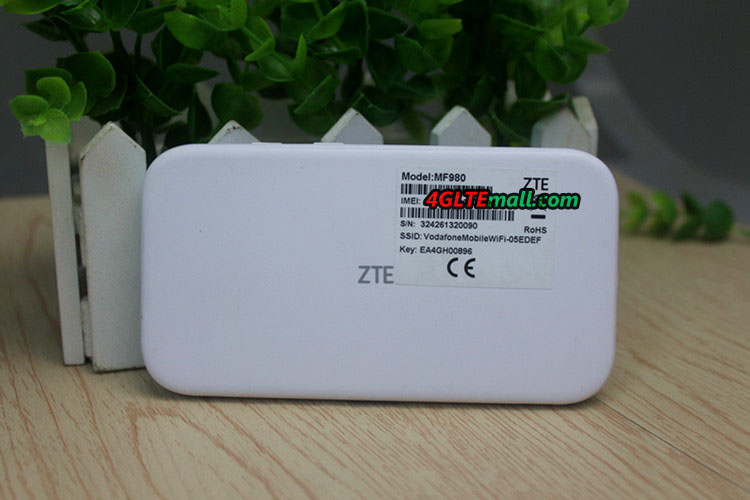
With the development of the LTE technology and deployment of LTE-advanced networks, the manufacturer offer new 4G mobile gadgets to meet the market required. The ZTE MF980 Hotspot is a 4G mobile hotspot that offers LTE Category 9 carrier aggregation technology. The specifications for ZTE MF980 makes it’s dominates in the mobile hotspos in the market.
Technical Specifications
This 3-band technology allows reach a download speed of 450 Mbps and 50 Mbps in upload. The bands supported in FDD are: B1 / B3 / B5 (26) / B7 / B8 / B20 / B28 / B32
For Europe area, the bands that concern in 4G are therefore B3, B7, B20 but also the B28 which supports the 700 MHz of Free Mobile.
For the rest the supported bands are:
* TDD-LTE: B40 (or B38 or B41)
* UMTS: B1 / B5 / B8 / B2
* GSM: 850/900/1800 / 1900MHz
A fairly wide coverage therefore, makes the ZTE MF980 mobile hotspot a good partner for traveling. We do not have exactly the carrier aggregation of supported 3 bands, but we remain optimistic for a support in France (B20 + B7 + B3 or B28 + B7 + B20).
Wireless Features
The ZTE MF980 also offers Wi-Fi 802.11 ac running dual-band 2.4 GHz and 5 GHz simultaneously. And up to 32 users can connect to the MF980 hotspot for internet access. It is of course also compatible with the 802.11b/g/n and it also offers a 2 × 2 MIMO technology.
The 1.44-inch color TFT screen allows you to view the usual information such as the operator, connection type and level, battery level, number of users connected and data consumption.
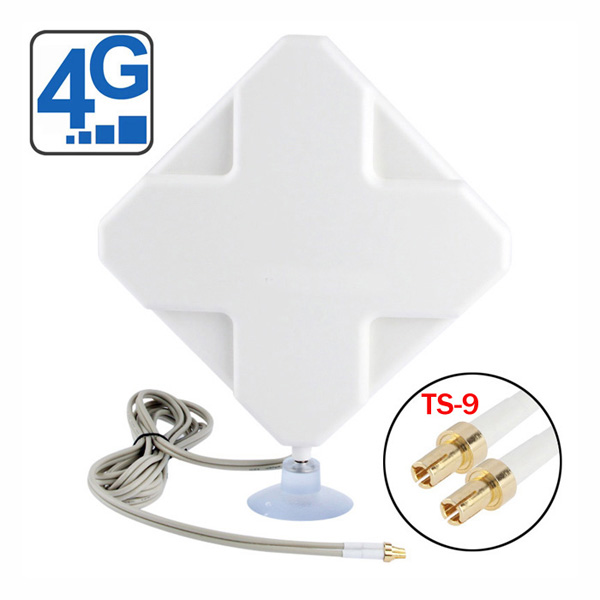
The ZTE MF980 is small enough to fit easily in the pocket or in a bag. What’s more, it has 2 connectors for external antennas, which makes it possible to connect external antenna to improve the signal strength so as to get faster surfing speed. The connector type is TS-9, we recommend below the external antenna for ZTE MF980 mobile hotspot: http://www.4gltemall.com/4g-antenna-two-ts-9-connector.html
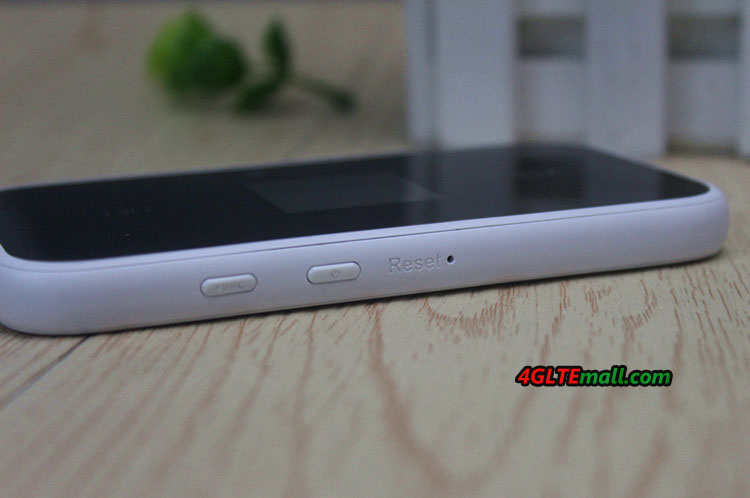
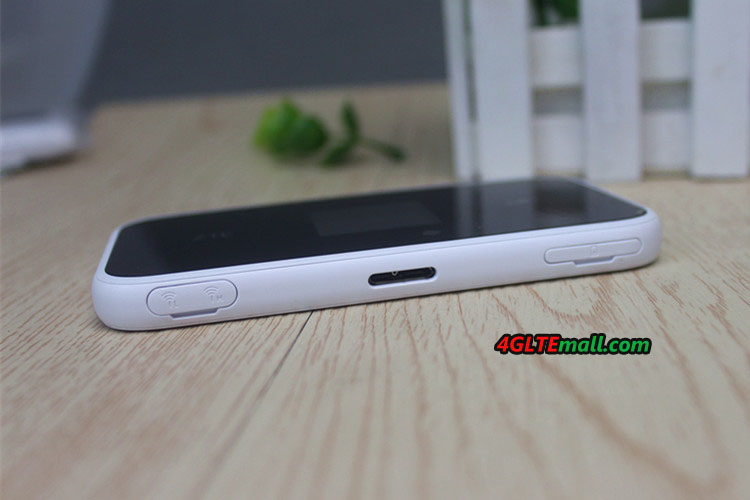
It has a micro-USB port and a slot for micro-SIM. Equipped with a 2200 mAh battery, it can keep working for up to 10 hours according to the manufacturer. It is compatible with the Android application (or IOS) ZTELink APP.
Summary
With the support of LTE Cat.9 and 3 band carrier aggregation, ZTE MF980 supports fast download speed to 450Mbps while currently the LTE Cat.6 up to 300Mbps is the mainstream. Up to 32 wireless users could access internet with the ZTE MF980 and large battery of 2200mAh, which makes MF980 a powerful partner for outdoor activities. The possibility of connecting external antenna and control via ZTELINK app is also very useful for operation.
Actually, there are many LTE cat.9 and cat.11 mobile hotspots in the market now, such as the Netgear Aircard 810s hotspot etc. They already get great fame from the end-users. We suppose the ZTE MF980 would also be a good star for LTE-A networks.
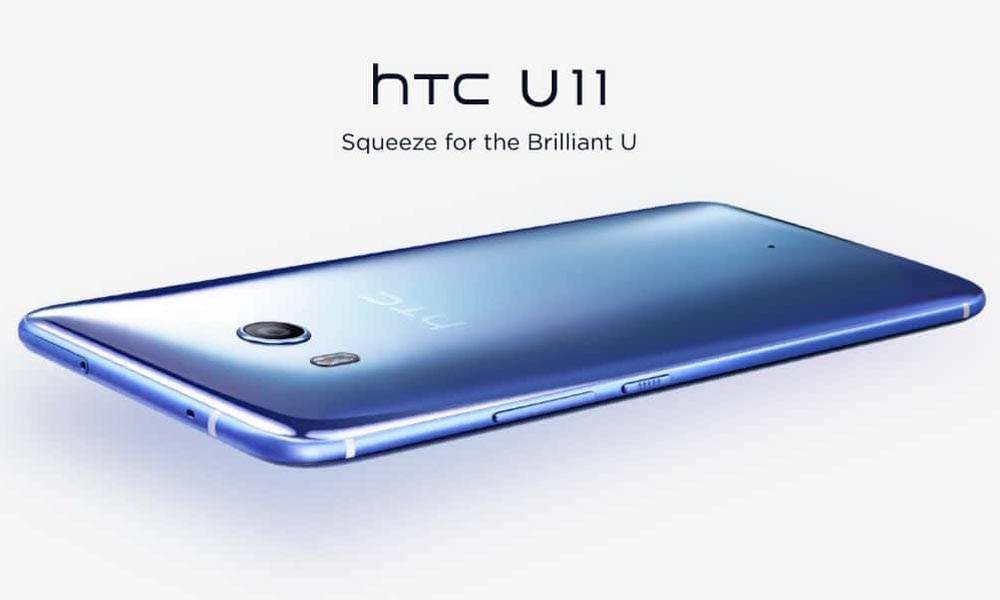
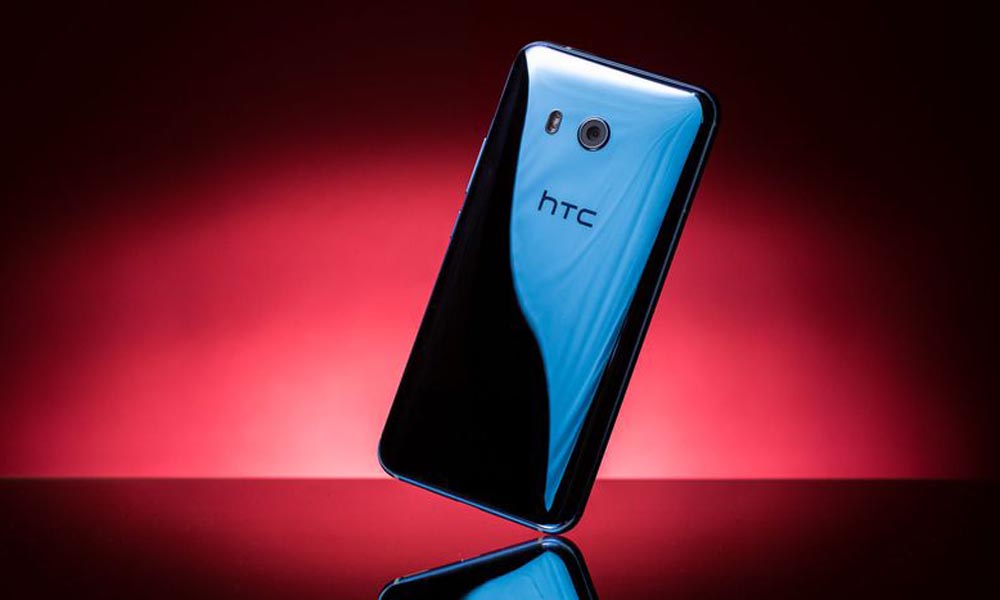
HTC has introduced a new flagship smartphone: the HTC U11. The successor of the HTC 10 starts with very good technical data as a direct competitor to the Samsung Galaxy S8, LG G6 and Sony Xperia XZ Premium in the market. In free trade, the HTC U11 is sold as a dual SIM version, which is rather untypical for flagship smartphones \and therefore particularly interesting. Also quite extraordinary: the HTC U11 comes with the latest Qualcomm chipset, the Snapdragon 835. The X16 modem included offers LTE category 16, depending on the network, data rates of up to 1 Gbit/s are possible. Higlight is the pressure-sensitive body (“Edge Sense”) as well as the ultrapixel camera.
Design with glass and metal
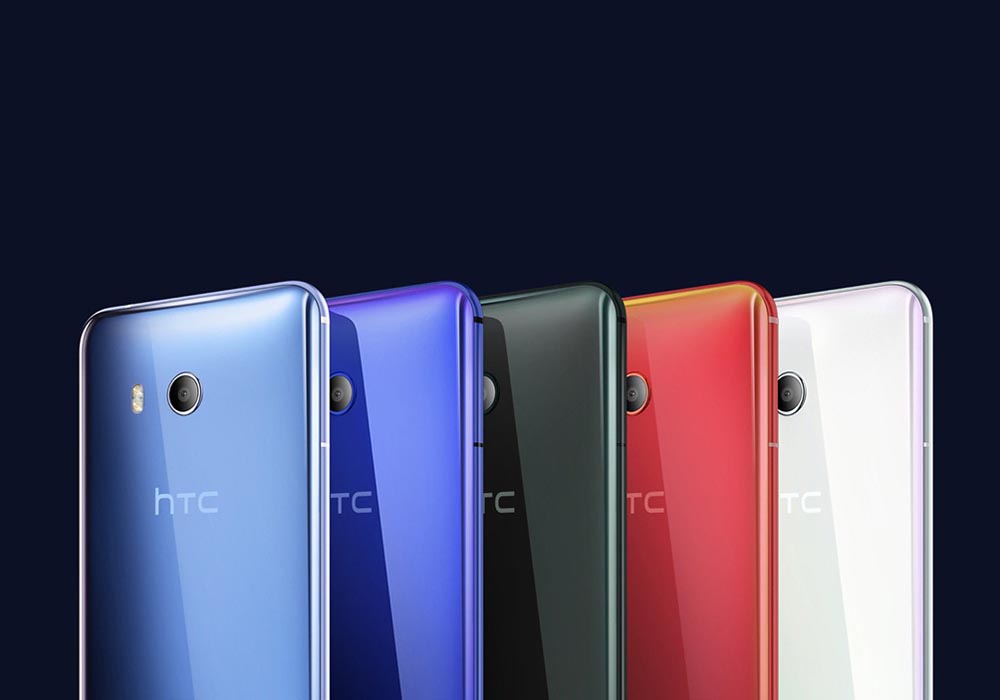
The 2016 flagship HTC has yet shipped with a metal case, the HTC U11, however, has a glass back, as you already know from the HTC U Ultra. Only the frame is still metal. There are a total of 5 different colors, but some colors such as red may comes later available.
The display is based on a 5.5 inch LCD with a 16: 9 aspect ratio (2560 x 1440 pixels) protected by Corning 3D Gorilla glass. Unlike LG on the G6 or Samsung on the S8, the HTC U11 does not have a special aspect ratio, which affects the dimensions of 153.9 x 75.9 x 7.9 millimeters.
A particularly innovative feature is “Edge Sense”. The HTC U11 reacts laterally in the lower body area to pressure, so certain functions can be started quickly and easily, for example the camera. Basically Edge Sense is freely assignable, in the summer HTC would like to make an app available, which should then also allow macros.
Art technology
HTC is one of the first manufacturers to introduce the modern Qualcomm Snapdragon 835 chipset. The heart of the smartphone contains many important components, especially processor, modem and WLAN chipset. The processor is a 64bit octa core, clocked at up to 2.45 GHz per core. The entire chipset is manufactured in the 10nm process and is therefore particularly energy-saving. The HTC U11 stands in the variant with 64 GB user memory by the way 4 GB of RAM available. A memory expansion via MicroSD card is possible; however, the dual SIM function is blocked.
The HTC U11 is especially up-to-date with the integrated modem. The Qualcomm Snapdragon X16 modem supports up to 1 Gbit/s in the LTE Cat16 downlink, up to 150 Mbps in the LTE Cat15 uplink. This is made possible by up to four bundled LTE frequency bands (4CC Carrier Aggregation) and by the 256QAM modulation in the downlink. The real speed that can be achieved depends, of course, also on the mobile network, in some countries, currently up to 500 MBit/s via LTE is possible. VoLTE and WiFi calling are, of course, also supported, as long as the network operator offers these services in his network. The LTE frequency ranges, which are supported by the HTC U11 as below:
In particular the support for band 28 (700 MHz) and band 32 (1500 MHz) is interesting. Currently, these frequency ranges are not yet used by the network operators, but this is likely to be relevant in the future and the HTC U11 is therefore very well equipped for the coming years.
Very good camera
The camera has been the focus of HTC’s flagship models for years. Also the HTC U11 is the camera to be a highlight. It offers a resolution of 12 megapixels on the back and a resolution of 16 megapixels on the front. UltraPixel 3 technology is used on the back, 1.4μm pixels are designed to allow a lot of light to enter the sensor. According to DxO-Mark, HTC has the U11 as the currently best smartphone camera on the market.
Available from June
The HTC U11 can be pre-ordered immediately and is available from June. Some network providers may offer the single card version, but there is also dual-sim version on www.4gltemall.com .
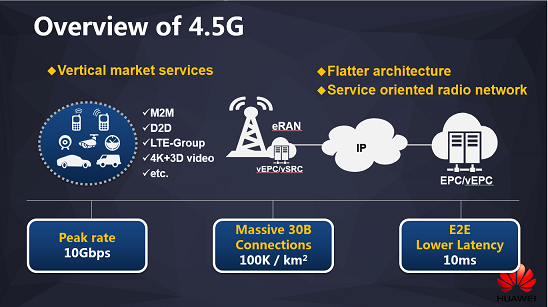
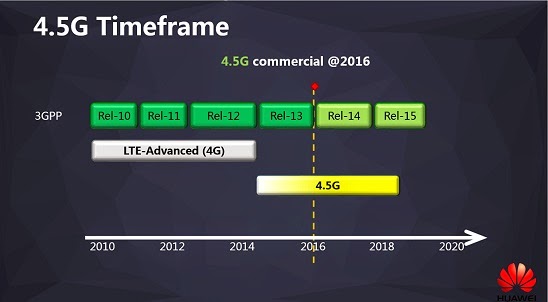
LTE Advanced Pro or 4.5G is a very up-to-date topic in the mobile world. Although the LTE successor 5G is talked much, 4.5G is already used by the network operators, and it already active and already contains many features, which will later also play a large role in 5G. Many carriers in Europe, such as Vodafone and Telekom, have already carried out initial tests with 4.5G or LTE Advanced Pro, which was launched to market shortly before. What you will understand exactly under 4.5G is to be explained in this article.
4.5G: Features
Right from the start: whether 4.5G or LTE Advanced Pro is the same. It is the successor of 4G and/or LTE Advanced. According to the Global Mobile Supplier Association (GSA), a network must support the following standards to be officially considered a 4.5G network:
One of the following features:
Ultra short latencies, ULL (ultra-low latency)
An extension for machine communication, eg NarrowBand-Iot (NB-IoT) or eMTC
Additionally, at least one of the following features:
4 or more bundled downlink frequency ranges (4CC Downlink Carrier Aggregation, CC here for Component Carrier)
The aggregate spectrum aggregated with carrier aggregation exceeds 60 MHz
2 or more bundled Uplink frequency bands (2CC Uplink Carrier Aggregation)
License Assisted Access (LAA), ie the additional use of unlicensed radio spectrum, eg in the 5 GHz frequency range
Vehicle-to-X communication (V2X)
Mission Critical Push to Talk (MCPTT)
Network extensions for improved indoor positioning
The V2X communication is already being tested under some carriers’ networks, for example Vodafone. Recently, there was a corresponding demo at the Mobile World Congress together with the network equipment supplier Huawei. In theory, Vodafone could also bundle significantly more frequency spectrum and thus introduce 4CC or 5CC carrier aggregation, but the provider has so far restricted itself to Triple Carrier Aggregation (LTE 800 + LTE 1800 + LTE 2600).
NB-IoT is used in the LTE band 8, that is to say in the 900 MHz range parallel to GSM, and band 20 (800 MHz) is also to be used. Up to now Telekom has bundled three frequency bands by means of carrier aggregation. In the future, however, the vendor could easily add additional carriers such as Band 8 (900 MHz) or Band 1 (2100 MHz). A significant increase in the downlink speed should therefore be possible in the near future. The use of 4 × 4 MIMO is also being tested in some locations and within the framework of its 5G, Vodafone has long been working on measures to further reduce latencies. Surely these ULL features will also be implemented in the 4.5G network.
What does 4.5G bring to the end customer?
Many 4.5G features are particularly interesting for communication with machines or between machines, eg NB-IoT or ULL. As an end customer with a modern smartphone (from LTE Cat11 or newer, eg Huawei P10 or LG G6), there is one benefit: the maximum possible speed is much higher than what is so far. The expansion of LTE on other frequency bands, eg band 8 or band 1, will allow better network coverage in some places. Massive MIMO, in particular, will have a significant improvement in the average speed for the individual user, particularly at locations with very high capacity utilization.
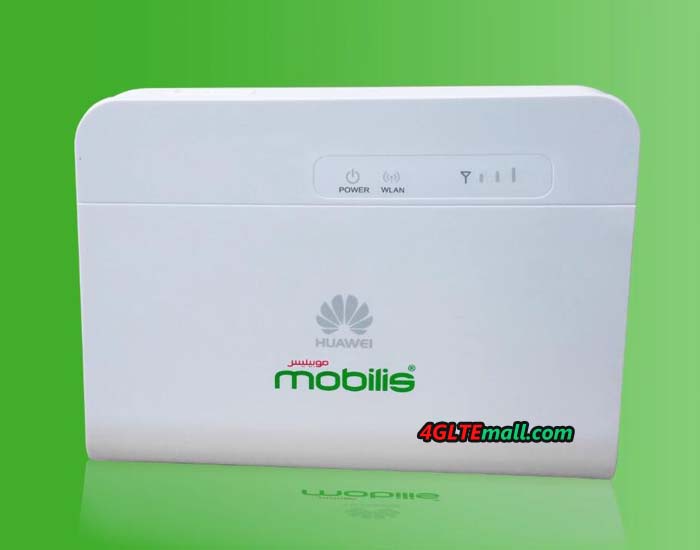
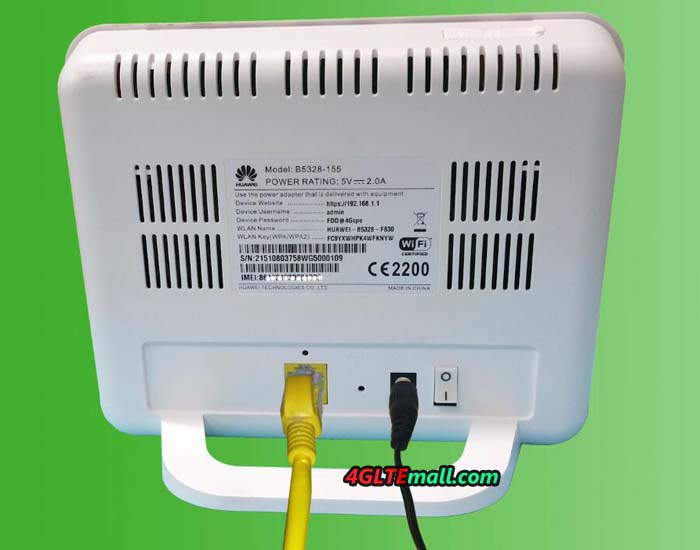
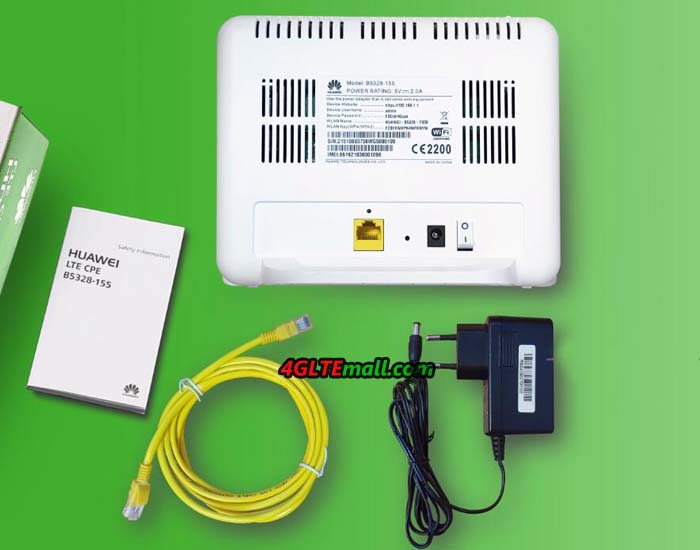
Released in at the beginning of 2016, Huawei B5328 LTE Router is only distributed to few telecom operators who wish to offer it to their customers with a 4G offer till now. As we know, it’s now available only for the network provider Mobilis in Algeria, and other carriers such as China Mobile, Vodafone are trying to test their network with the new 4 X 4 Mimo technology.
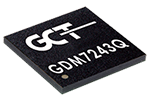
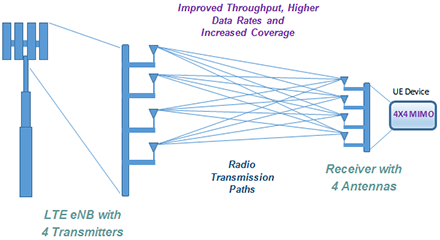
The particularity of this B5328 LTE router is that it is one of the few devices to offer a LTE-A 4X4 MIMO technology. Based on the GCT’s GDM7243Q, the only LTE-A chip commercially available that offers 4×4 MIMO capability, enables Huawei B5328 LTE CPE with higher data rates and throughput while using limited bandwidth (“double speed” with the same limited bandwidth), which is a scarce commodity for network operators.
GCT GDM7243Q chipset features:
* Supports FDD-TDD LTE Cat5/6/7
* Cat5 LTE with 4×4 DL MIMO: 300Mbps DL, 75Mbps UL
* Cat6 LTE with 4×2 carrier aggregation: 300Mbps DL, 50Mbps UL
* Cat7 LTE with 4×4 MIMO or carrier aggregation with 300Mbps DL,100Mbps UL
* Dual processor architecture: ARM Cortex-A7 with 832MHz clock frequency. Application CPU + Modem CPU (LTE)
* On-Chip VoLTE (HD-Voice)
* SoftAP for external WiFi client
GCT GDM7243Q Semiconductor
GCT GDM7243Q chipset is often used on 2X2 MIMO for telecom, which has few advantages, but its availability makes it possible to use 4X4 MIMO in near future.
In this version Huawei B5328-155, it has a single Gigabit Ethernet port and the WiFi band is only on 2.4 GHz, which seems not enough for a high-end router, and the 4 x 4 mimo technology is only highlights.
After the Algerian Internet users who have the possibility to use this B5328 router via the operator MOBILIS, Vodafone also carries out tests in 4X4 MIMO on its 4G network. And it seems that the operators in German, Switzerland and Austria are in discussions with Huawei.
Here now, the latest 4G LTE Router is Huawei E5186, which is LTE Category 6(Rel 12). After Huawei presents the B5328 LTE CPE, we would expect more similar 4G LTE Routers available in near future. Of course, the routers would do their best performance after the network carriers upgraded their networks.
Looking at the current available 4G LTE Mobile Hotspot, Netgear seems lead the LTE Advanced terminals. If you had known Huawei E5786 mobile WiFi, you may think this is the fastest 4G pocket router. However, if you know the two 4G mobile routers which we would introduce today, you may have a new view for the mobile terminals.
Since LTE Cat3 and Cat4 are becoming the mainstream for carriers, LTE-advanced would of course be available in near future. Here we can see some carriers are stepping fast. The carrier AT&T in USA and Telstra in Australia had presented the LTE Advanced networks for commercial use. The aforementioned Huawei E5786 is a LTE cat6 mobile router, which is already available for many network providers. AT&T and Telstra already used the LTE Cat9 and Cat11 terminals, which mean the LTE Cat9 and Cat11 technologies are available for the two carriers.
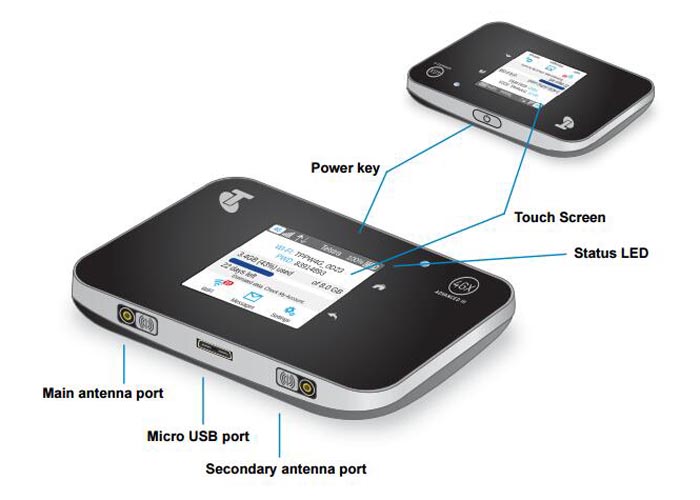
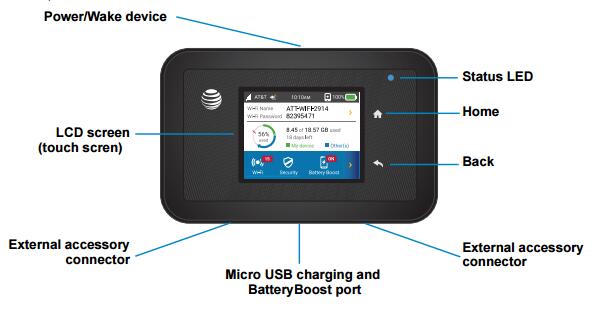
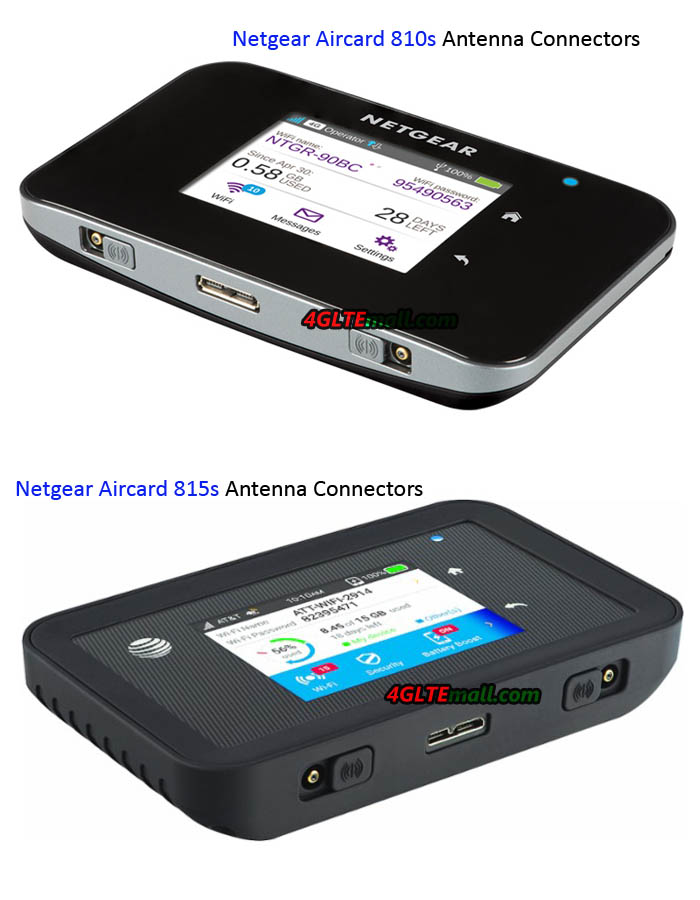
AT&T introduced Netgear Aircard 815s and had a new name “AT&T Unite Explore” while Telstra introduced Netgear Aircard 810s and has a new name of “Telstra WiFi 4GX Advanced III”. The two 4G mobile hotspots very similar in the name but feature differently. Today, we will have what’s the difference between them.
Aircard 810s vs 815S Appearance
The Netgear Aircard 810s follows the design of the predecessor Aircard 790s, which is a same level mobile router to Huawei E5786 supporting LTE Cat6. The body of Aircard 810s is made of plastic but feels good. With a 2.4 inch LCD screen, user can read the connection status and setup the routers on the screen.
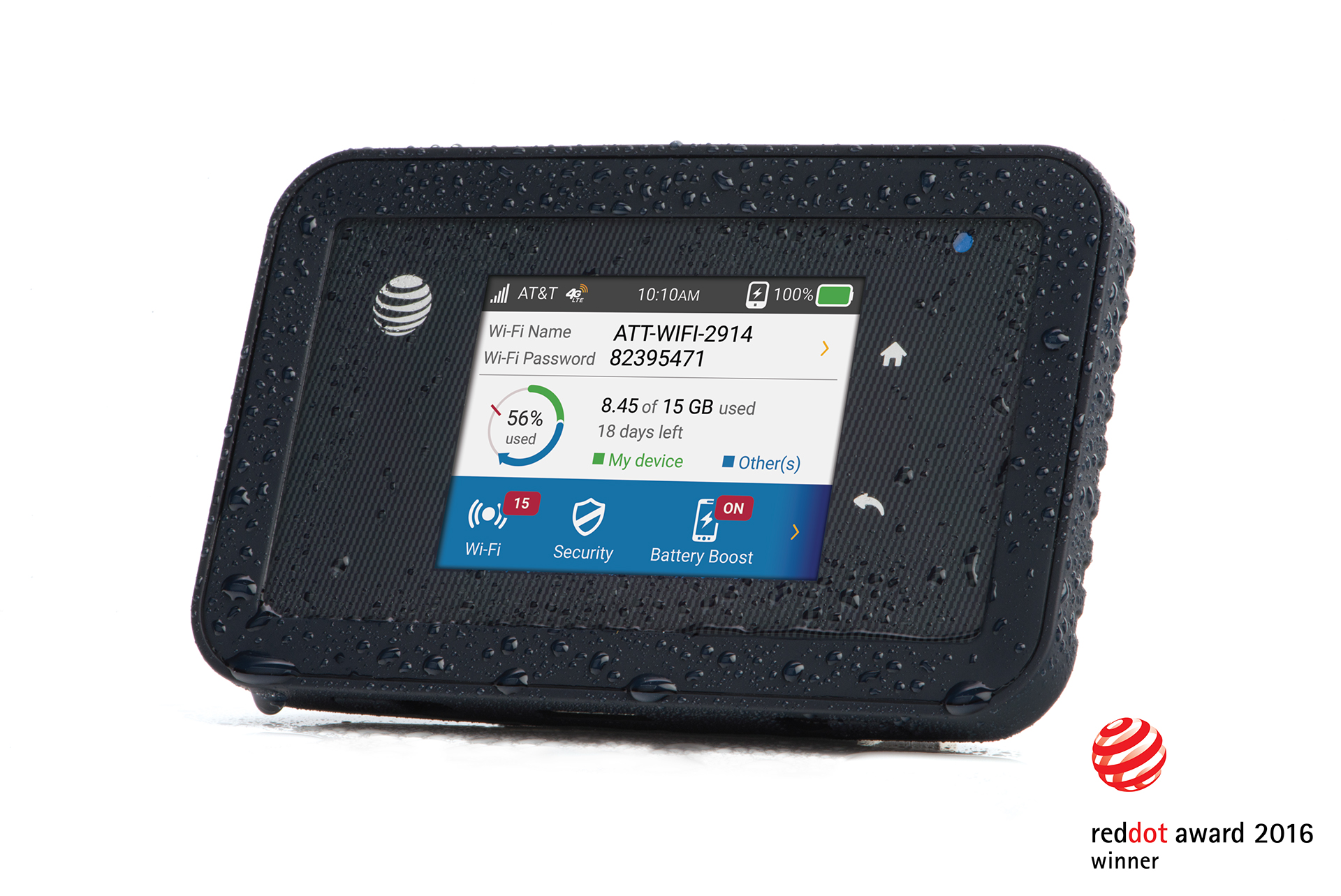
The Netgear Aircard 815s also has a 2.4inch QVGA capacitive touchscreen like Aircard 810s. So the screen has same functions to Netgear AC810S for settings. There special feature of Aircard 815s which should mention is the rugged design that is dustproof, shock and water-resistant. This feature allows users to take the Aircard 815s not only for common outdoor activities, but also in severse weather, especially for the wilderness exploration. They both have two connectors for external antenna and socket type is TS-9. Between the two connectors, there is a USB 3.0 port.
Netgear AC810S VS AC815S Technical Specifications
Below the blank shows the details specifications of the two routers:
Actually, we had not tested the two units at same network environment in practice. But we will do that respectively in near future and will provide full test report for the two mobile hotspots. We hope the report would be a good reference for the potential users who need the 4G mobile routers.
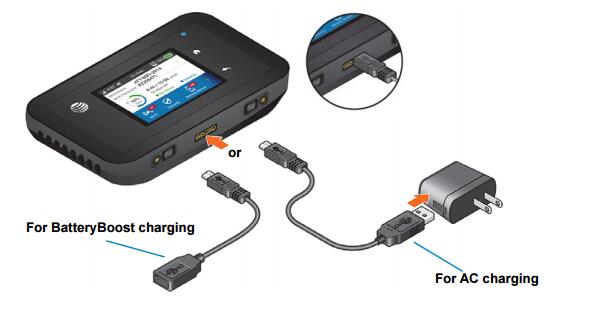
There is one function that we have to mention: The Aircard 815s and 810s can both work like a mobile power bank, which is called Battery Boost, they can charge other electronics such as smartphones and tablets. This function is practical and useful in most cases.
From the appearance and specifications, we can see the two mobile routers (Aircard 815s and 810s) are with the latest technology and dominate the wireless terminals. Netgear Aircard 810s supports higher level network technology and it should be the fastest 4G mobile router. Of course, the price is also not cheap for the Aircard 810s, so as Aircard 815s. But if you would like a budget mobile pocket 4G router, the Netgear Aircard 790smay be a good option for you.