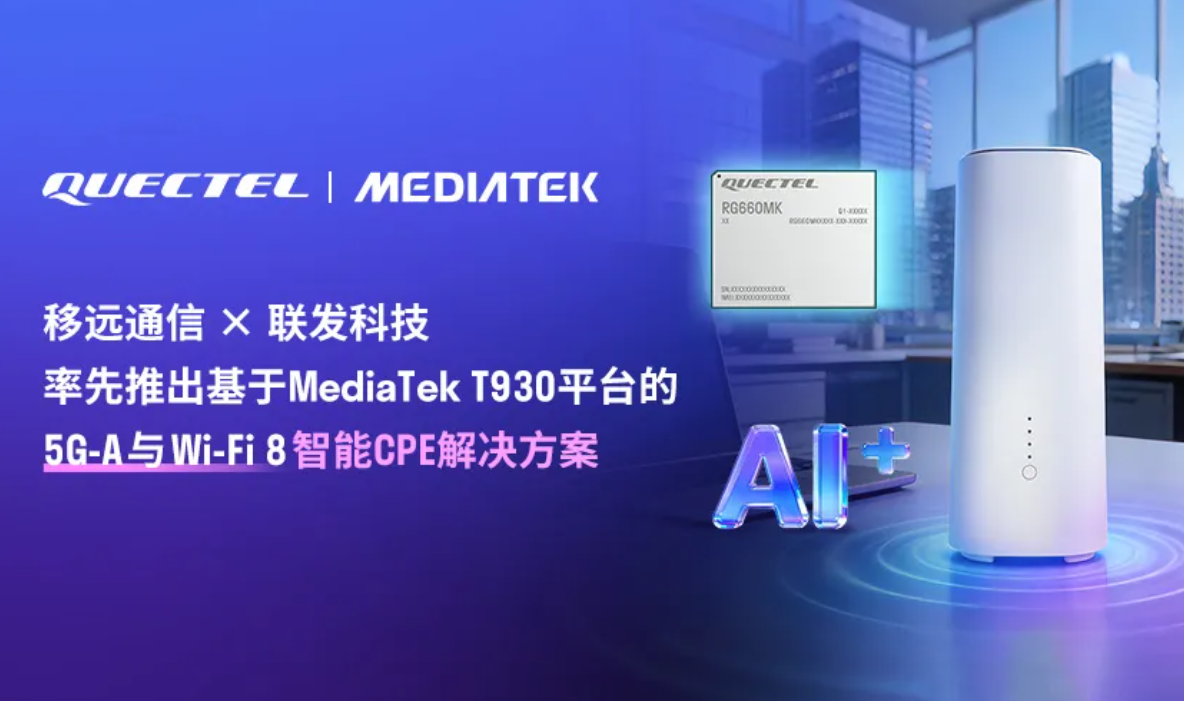
Quectel Launchs the Automotive-grade 5G R18 Module AR588MA

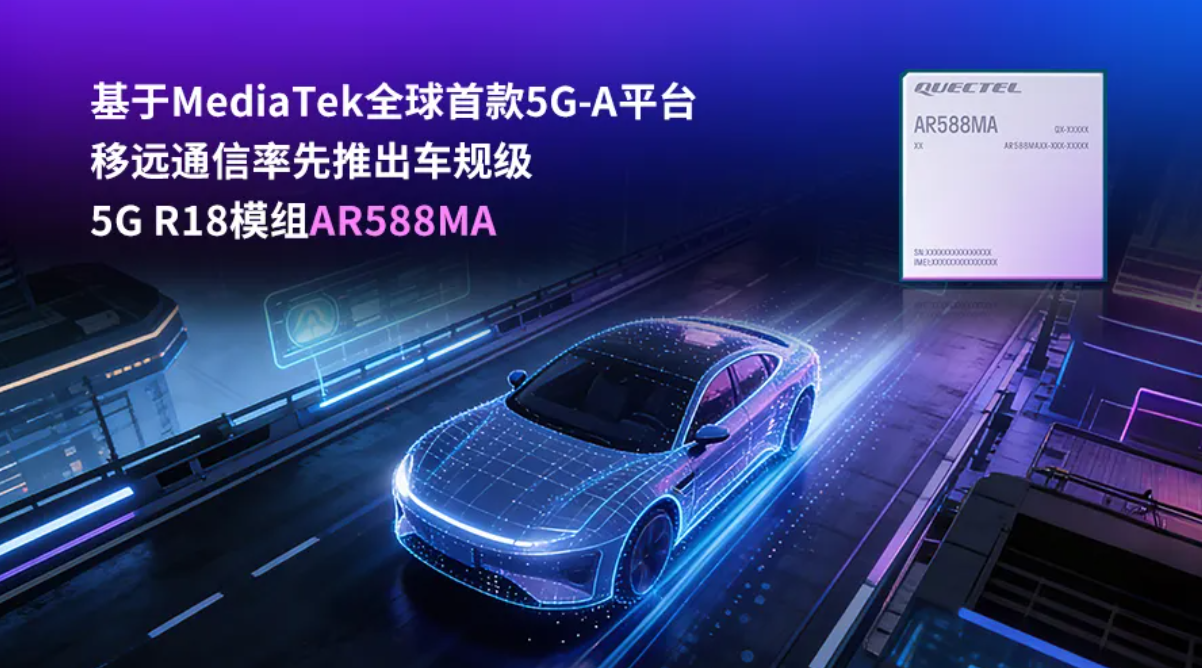
On January 4, just before the 2026 International Consumer Electronics Show (CES 2026), Quectel Communications, a global leader in IoT and V2X (Vehicle-to-Everything) solutions, announced the launch of its automotive-grade 5G-A module AR588MA, compliant with the 3GPP R18 standard.

This series of 5G modules is built on MediaTek’s world’s first 5G-A platform, MT2739, achieving four core breakthroughs: comprehensive signal coverage, high-speed data transmission, AI-based intelligent network adaptation, and automotive-grade safety assurance. These features strongly support the innovative development of the next-generation intelligent connected vehicles. Currently, the module is offering engineering samples externally, and several leading automotive companies have already initiated the implementation of the AR588MA series.

“Ground + Satellite” Full Coverage, More Reliable High-Speed Transmission

As an automotive-grade module based on MediaTek’s first 5G-A platform, the Quectel AR588MA series modules feature leading modem performance in the industry. It includes a built-in quad-core Cortex-A55 CPU with a clock speed of up to 2.3GHz, enhanced upstream transmission capabilities, and ultra-low latency, supporting a bandwidth of 400 MHz and NR 5CC, with downstream speeds reaching up to 9.0 Gbps and upstream speeds exceeding 2.5 Gbps. It also supports DSDA (Dual SIM Dual Active) functionality, enabling more efficient and stable data transmission and real-time processing while maintaining stable network connections, thereby laying a solid communication foundation for the safety and reliability of advanced driver-assistance systems.
At the same time, Quectel AR588MA has achieved significant breakthroughs in comprehensive communication capabilities. It not only supports 5G-A technology but also integrates satellite communication functions. Combined with enhanced low-frequency reception performance and adaptive network signal compensation algorithms, it significantly improves network performance while ensuring full-scenario communication coverage. Even in weak signal areas like basements and remote mountain regions, vehicles can maintain stable connectivity, effectively addressing the pain points of ground network coverage blind spots and ensuring communication continuity in complex environments.

In terms of wireless performance optimization, the AR588MA is compatible with a six-port antenna design, deeply adapting to Quectel’s high-performance intelligent antenna solutions, thus achieving deep integration of module and antenna performance, providing users with wide coverage and strong signal wireless network performance.

AI Intelligent Adaptation, Smoother Network Experience

During this critical period of advancement in intelligent connected vehicles, users have raised higher demands for the smoothness of in-vehicle network experiences.

One of AR588MA’s core competitive advantages lies in its deep integration of AI technology with in-vehicle communication, achieving an upgrade from “passive connectivity” to “active adaptation.” The module features an intelligent driving scene recognition system and an AI network optimization engine, with processing capacities of 25K DMIPS for quad-core and 13K DMIPS for dual-core. It can real-time integrate multidimensional data, including vehicle positioning, speed, and road conditions, automatically matching optimal network modes, significantly enhancing network speed and connection stability, and providing users with a smoother in-vehicle network experience.

Automotive-Grade Core Quality, Dual Assurance of Safety and Reliability

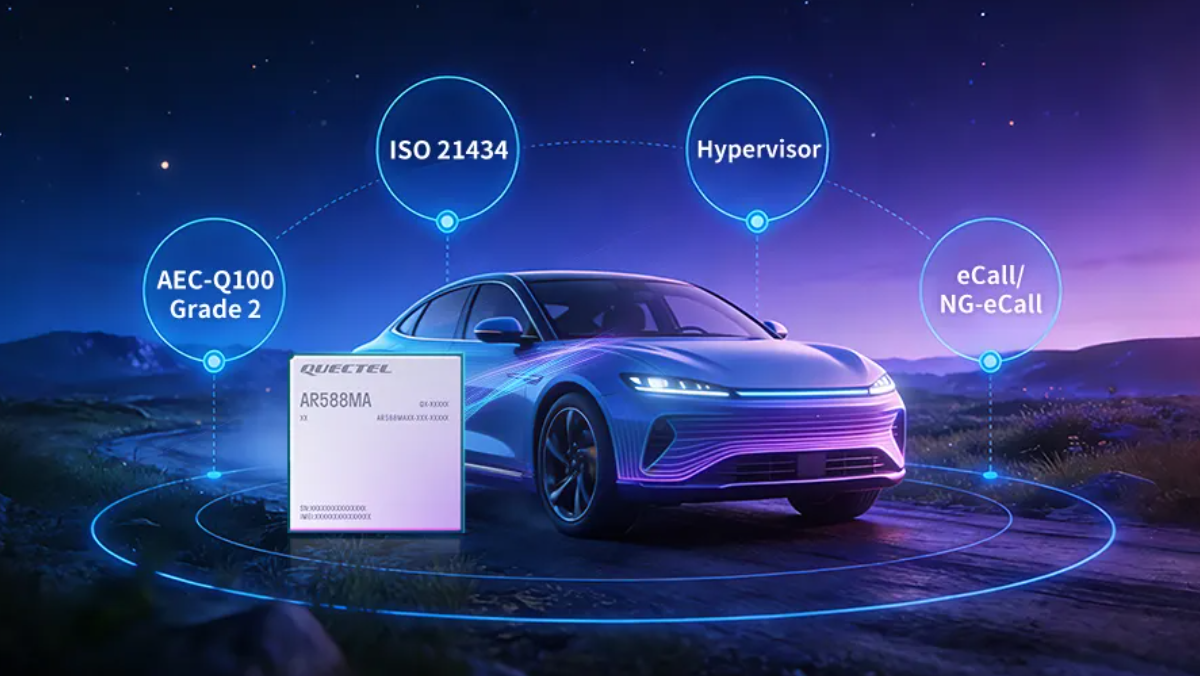
The reliability of automotive products is directly related to driving safety. The Quectel AR588MA strictly adheres to automotive-grade design standards and safety systems, fulfilling AEC-Q100 Grade 2 automotive specifications to ensure product reliability and durability in extreme environments. Additionally, it complies with ISO 21434 automotive cybersecurity management standards and supports Secure Boot and RoT (Root of Trust), combined with Hypervisor hardware isolation technology to provide a more stable connectivity experience and more reliable safety assurances for in-vehicle communication.

On the functional side, the AR588MA fully supports eCall/NG-eCall emergency calling systems, which can automatically trigger a call and transmit critical data such as vehicle location and accident type to emergency centers in the event of a collision or other emergencies, buying precious time for rescue operations. To further enhance vehicle positioning reliability, this module also integrates GNSS positioning capabilities, supporting dual-frequency positioning with L1 and L5, outputting at a frequency of up to 30Hz, providing precise location support for path planning and lane-level navigation for assisted driving.
Compatible Design for Easy Upgrades, Accelerating 5G-A Implementation in Vehicles

To reduce customer development costs and shorten product launch cycles, the AR588MA employs a highly compatible design approach at both hardware and software levels.

On the hardware front, it is pin-to-pin compatible with Quectel automotive 5G modules AG581A, AG56xN, and AG519M series, allowing customers to quickly upgrade from traditional 5G to 5G-A. On the software side, it utilizes the QuecOpen architecture, leveraging excellent cross-platform and cross-system compatibility to assist automotive enterprises in seamless system migration, significantly shortening product development and validation cycles.
Quectel Launched RG660QA & RG660QB 5G-A AI + Wi-Fi 8 Module

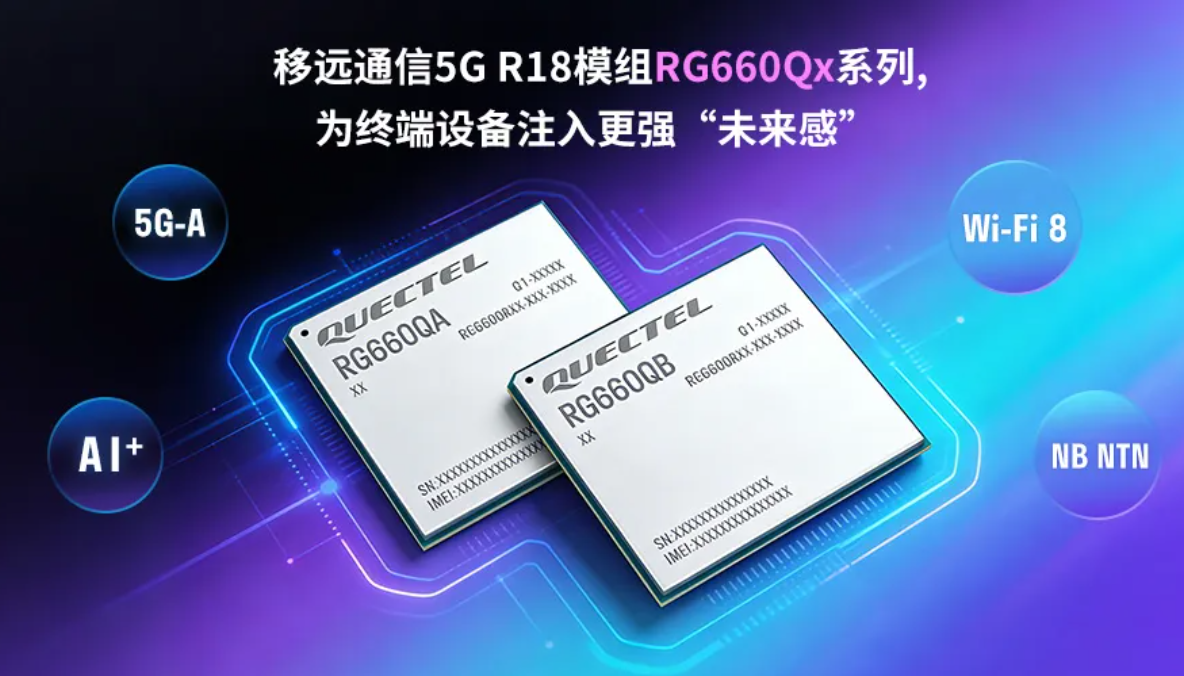
On January 9, during the 2026 International Consumer Electronics Show (CES 2026), Quectel, a global leading provider of IoT total solutions, announced the launch of its groundbreaking 5G-Advanced module series RG660Qx, compliant with the 3GPP R18 standard. This series is set to redefine the performance benchmarks and experiential boundaries of next-generation smart connectivity through the power of cutting-edge technology integration.

Among the series, the Quectel RG660QA is based on the Qualcomm X85 platform, maximizing the peak performance of 5G-A; while the Quectel RG660QB is equipped with the Qualcomm X82 platform, precisely meeting the demands of mainstream high-end connected smart applications. This series of modules uniquely combines key capabilities including ultra-high-speed 5G-A communication, collaboration with Wi-Fi 8, and AI enhancement. They can also be upgraded to support NB NTN satellite communication, thus comprehensively empowering next-generation cutting-edge smart applications such as home and commercial wireless broadband, high-definition mobile video, and high-performance mobile hotspots, injecting a stronger sense of “futurism” into terminal devices. The first batch of engineering samples from the RG660Qx series has officially been released to global customers, with the Quectel RG660QB series expected to go commercial in Q1 2026.

Quectel COO Zhang Dong stated, “The Quectel RG660Qx series not only elevates 5G communication capabilities to a new level but also represents a future-oriented integrated smart product. Leveraging the Qualcomm X8x platform, this series offers extremely high speed, outstanding performance, and exceptional reliability, precisely matching the multiple connectivity, computing, and intelligence needs of ultra-high-speed fixed wireless access (FWA), enterprise-grade gateways, and high-end consumer electronics. We hope that the RG660Qx series significantly lowers the threshold for innovation for our customers and accelerates the emergence of next-generation smart terminals.”

High-Speed and Stable Dual Online: Maximizing 5G-A Communication Strength

In terms of core communication performance, the RG660Qx supports a maximum of 8-channel or 6-channel receiving in the downlink, and supports FDD (2 Layers) + TDD (2 Layers) UL Switch. With advanced Multi-Input Multi-Output (MIMO) technology, the RG660Qx series excels in increasing data transmission rates, optimizing signal quality, and ensuring connection stability, capable of providing high-speed, stable wireless experiences for next-generation 5G applications, including gigabit-level fixed wireless access, essential enterprise services, and high-capacity mobile broadband.

Meanwhile, the RG660Qx series can be upgraded to support Dual SIM Dual Standby (DSDS) and Dual SIM Dual Active (DSDA) functions, flexibly adapting to multi-carrier network switching needs and confidently addressing complex global network environments to ensure continuous online access for businesses.

For key scenarios like indoor 5G CPE, this series of modules can simultaneously support Wi-Fi 7 and Wi-Fi 8 technologies across the 2.4 GHz, 5 GHz, and 6 GHz bands, and integrate Bluetooth functionality, building a comprehensive intelligent interconnect ecosystem. Its Ethernet interface supports rates of up to 10 Gbps, enabling large-capacity data transmission for ultra-high-definition video streaming and enterprise-grade networks. Supporting power level 1, it can effectively extend signal coverage, further enhancing coverage capability in FWA deployment scenarios.

Integration of Multiple Advanced Capabilities Empowering All-Scenario Smart Connectivity

AI enhancement capability is one of the core highlights of the RG660Qx series. Through modem capability upgrades and AI-enhanced Wi-Fi, along with a dedicated AI co-processor featuring 24 TOPS of computing power, this series of modules can easily realize intelligent interaction functions such as voice control. Additionally, it supports external AI computing power modules to further enhance edge-side data processing and intelligent decision-making capabilities, providing core computing support for scenario-based applications of smart terminals.

Besides AI capabilities, the RG660Qx series simultaneously reinforces all-scenario connectivity capabilities: it supports a variety of interfaces including USXGMII, USB, and PCIe, allowing deep cooperation with Wi-Fi chipsets to fully leverage the advantages of Wi-Fi 8 in network reliability and intelligence, significantly enhancing the application experience of devices such as 5G CPE and high-performance mobile hotspots.

The breakthrough in all-area coverage capabilities further underscores the technological foresight of the RG660Qx: the Quectel 5G module can be upgraded to support the NB NTN satellite communication function (requires specific hardware design), forming a complementary relationship with terrestrial network coverage, achieving stable connectivity in remote areas, oceans, deserts, and other locations without ground network availability.

Hassle-Free Hardware Upgrades Accelerating Industry Implementation

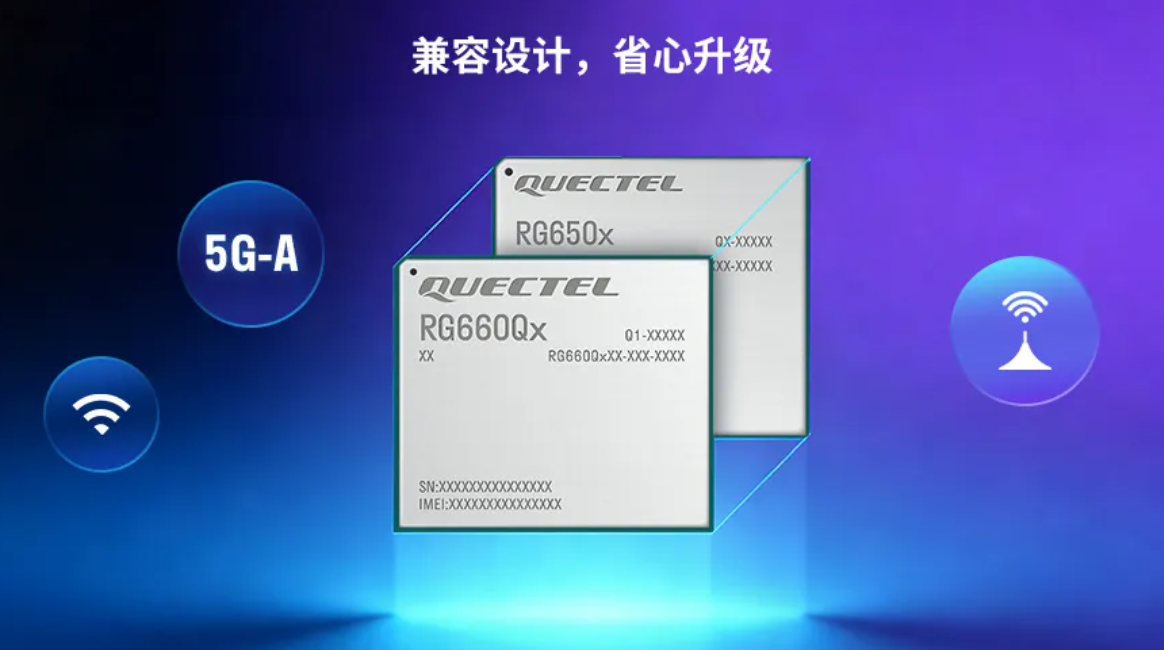
To accelerate industry adoption, the RG660Qx series is Pin-to-Pin compatible with Quectel’s previous 5G module series RG650x, allowing customers to use the same recommended Wi-Fi chips and physical layer chip solutions from the RG650x series without the need to reconstruct hardware design for swift upgrades, significantly simplifying R&D processes and optimizing supply chain efficiency. Meanwhile, Quectel can also provide high-performance antenna products and comprehensive technical support to help customers speed up product development and shorten the time to market.

From breakthroughs in 5G-A link performance to forward-looking interconnect strategies with Wi-Fi 8, along with synergies between AI enhancements and industry applications, the Quectel RG660Qx series not only demonstrates global leadership in communications technology but also establishes a foundation for next-generation smart terminal innovation through all-scenario coverage and flexible hardware compatibility. In the future, Quectel will continue to drive technological innovation, deepen industry collaboration, and accelerate the transition of 5G-A technology from “standard specifications” to “large-scale applications.”

Quectel Releases Next-Generation Flagship Smart Module SP895BD-AP

On January 6, the first day of the 2026 International Consumer Electronics Show (CES 2026), leading global IoT solutions provider Quectel announced the official launch of its next-generation flagship smart module, SP895BD-AP.

This module is powered by the Qualcomm Snapdragon™ Q-8750 processor, which offers enhanced graphics processing capabilities, superior imaging effects, and advanced AI computing performance. It is designed to meet the stringent demands of high-end devices such as video conferencing, ultra-high-definition displays, image synthesis, computation boards, smart retail, and smart home applications. It provides essential hardware support for the AIoT industry as it transitions from “basic intelligence” to “high-level smart computing.”

Quectel’s COO, Zhang Dong, stated: “At this critical juncture in the move toward ‘higher intelligence’ in AIoT, there is an explosive growth in the demand for computational power and multimedia processing capabilities in terminal devices. The newly launched flagship smart module SP895BD-AP is a key achievement for Quectel, grounded in industry needs and deepening our efforts in the edge intelligence field. Leveraging the Qualcomm Snapdragon Q-8750 processor, this module achieves significant performance enhancements in CPU, GPU, and AI engines, alongside 8K multimedia processing capabilities. It offers a solution that balances ‘computational power and energy efficiency’ for high-end AIoT scenarios, accelerating the digital transformation of the industry.”

Enhanced with 3nm Technology: A Double Leap in Performance and AI Computing Power

The SP895BD-AP redefines performance boundaries with its advanced hardware architecture. Featuring the Qualcomm Snapdragon Q-8750 processor, it employs a 3nm fabrication process and includes an octa-core high-performance Qualcomm Oryon™ CPU, with clock speeds reaching up to 2×4.32 GHz + 6×3.53 GHz. Compared to the previous generation (the 8 series chips), it achieves a 45% increase in CPU performance and a 44% improvement in energy efficiency. This allows it to maintain stable high-performance output in high-intensity scenarios such as multi-tasking and complex algorithm execution while minimizing power consumption, thereby balancing the demands for “computational power” and “energy consumption.”

The accompanying Qualcomm® Adreno™ 8 series GPU also exhibits outstanding performance, achieving a 40% increase in efficiency and energy optimization. Its unique tile-based architecture delivers stunning graphics effects and realistic environmental rendering capabilities, ensuring reliable performance for complex task handling and ultra-high-definition displays (8K Display/3D), easily meeting the high demands of graphic processing for high-end devices.

In the domain of edge AI computing, the SP895BD-AP brings groundbreaking advancements: the integrated AI engine achieves a computing power of up to 77 TOPS, marking a 45% increase over the previous generation. It supports INT4/INT8/INT16/FP16 full-precision computing modes, enabling real-time inference, and can even run large language models with up to 11 billion parameters on the edge. By integrating with multimodal perception technology, terminal devices equipped with this module can accurately recognize user contexts, facilitating multimodal interaction, and enabling generative AI assistants with real-time decision-making and personalized service capabilities, thereby establishing a “fully-covered, high-efficiency operation” foundation for edge AI development.

Multimedia Capabilities Maximized: 8K Ultra HD and Robust Imaging Input

In the field of multimedia processing, the SP895BD-AP sets a new benchmark. It supports 8K@30fps video encoding and 8K@60fps video decoding, significantly enhancing video bitrate processing and transmission efficiency. This enables “low latency transmission + high-fidelity reproduction” of ultra-high-definition videos, seamlessly aligning with the core requirements of 4K/8K ultra-high-definition displays and professional video conferencing equipment.

Its imaging input capabilities are equally robust: it features three integrated ISPs (image signal processors), capable of synchronously processing three streams of 48MP@30fps video input, and supports individual cameras with up to 108 million pixels for image capture, accurately capturing scene details to easily meet the needs of high-end imaging scenarios.

Flexible Adaptation: Hardware-Software Synergy Accelerating Scenario Implementation

To further adapt to the complex and diverse application ecosystem of AIoT, the SP895BD-AP has been fully optimized for its compatibility from “hardware flexibility” to “software compatibility.” Its hardware design utilizes LGA packaging, resulting in a compact size that can accommodate more product forms. Additionally, it is equipped with various peripheral interfaces, including MIPI DSI, CSI, PCIe, USB, I2S, UART, I2C, and SPI, to meet diverse display, audio, sensor, and communication expansion requirements, significantly enhancing scenario adaptability and deployment flexibility in AIoT applications.

On the software side, the module is designed to be compatible with a broader industry ecosystem, deeply supporting Android 15 and Linux operating systems, which greatly reduces the technological barriers for cross-field applications.

In the future, Quectel will continue to focus on the integration of edge intelligence and IoT technologies, investing and innovating to drive the deep development of industrial digital transformation with more cutting-edge products and more comprehensive solutions, injecting strong momentum into the construction of an intelligent world characterized by “everything being smart and full-domain perception.”

Quectel Releases Robot Computing Module SH602HA-AP at DDC2025

Recently, Quectel Communication officially launched the SH602HA-AP robot computing module, equipped with the Xuri®5 intelligent computing chip for sweet potato robots, which was showcased at the DDC2025 Sweet Potato Robot Developer Conference.

As a core computing solution for the new generation of general-purpose robots, the Quectel SH602HA-AP module boasts high computing power of 10 TOPS, an RTK + binocular vision fusion solution, and advanced on-device large model operation capabilities. These key advantages provide robots with essential technological support for precise navigation and obstacle avoidance, dynamic environmental perception, and more. This advancement aids industries in upgrading from “functional execution” to “perception and decision-making,” thus accelerating the commercialization process of robots on a larger scale.

In terms of core configuration, the Quectel SH602HA-AP module runs on the Ubuntu operating system. The embedded Xuri 5 chip is based on the advanced BPU Bayesian architecture and integrates abundant heterogeneous computing resources, offering up to 10 TOPS of AI computing power. This performance level can easily handle mainstream scenarios such as lawn mowers, cleaning robots, companion robots, and delivery robots, supporting efficient completion of full-stack computing tasks locally. It can also smoothly operate complex AI models and the latest algorithms such as Transformer, BEV, and Occupancy on the edge. Compared to traditional solutions, robots utilizing this module can not only accomplish basic object recognition and path planning but also efficiently realize advanced intelligent behaviors like scene understanding, natural language interaction, and dynamic obstacle avoidance.

More importantly, the Quectel SH602HA-AP achieves breakthroughs in low energy consumption while outputting high-performance AI computing power. In the complex field of robot terminal computing, it delivers better decision-making and task execution within limited time and computational resources, while also better aligning with the stringent requirements for heat dissipation control and lightweight design in robots.

If the computing architecture serves as the “intelligence core” of a robot, then the perception system acts as its “five senses,” interacting with the surrounding world. The SH602HA-AP module creates a complete integrated perception system, realizing an edge-side closed loop of “perception-computation-decision.”

In terms of perception capability, the module fully supports various sensor signal inputs and fusion processes, including LiDAR, structured light, ToF (Time of Flight), and voice. It incorporates core robotic perception algorithms such as dual-camera depth computation, AI + VSLAM (visual simultaneous localization and mapping), and 3D point cloud computation, combined with voice recognition capabilities, endowing robots with comprehensive intelligent abilities of “seeing, hearing, computing, and judging.”

In multimedia and visual processing, the SH602HA-AP performs exceptionally well, featuring a newly designed ISP 2.0 (Image Signal Processor) optimized for robotic scenarios, enhancing both latency and quality. The module’s maximum processing capability reaches 3840×2160@60fps, supporting advanced technologies such as 3D-NR (three-dimensional noise reduction), WDR (wide dynamic range), and HDR (high dynamic range), allowing it to accurately capture high-definition visual data in complex lighting environments. Additionally, it supports 4K@60fps video encoding and decoding, meeting the core demands for real-time visual transmission and processing in robots.

The interface configuration of the SH602HA-AP is remarkably versatile, encompassing 1×BT.1120, 1×DSI, 1×RGMII, 1×USB 3.0, 1×USB 2.0, 1×SDIO, 7×UART, 7×I2C, 1×QSPI, 2×I2S, and other abundant interfaces. Moreover, the module supports flexible external communication and positioning modules such as Quectel 5G, LTE Cat 1/4, Wi-Fi 6, and GNSS, allowing for quick integration of communication and high-precision positioning capabilities across various robotic applications.

Zhang Dong, COO of Quectel Communication, stated, “From lawn mowers and sweepers to cutting-edge humanoid robots, various forms of robots are profoundly reshaping human production and lifestyle. Quectel is committed to providing a solid edge-side computing and communication foundation for intelligent robots. The launch of the SH602HA-AP module not only achieves dual upgrades in computing and perception but, more importantly, significantly lowers the development threshold for high-end intelligent robots, injecting core momentum into industry innovation.”

Huawei 5G CPE Pro 6 H165-383 Review

The Huawei 5G CPE Pro 6 H165-383 stands as a groundbreaking 5G wireless router designed to bridge the gap between cutting-edge 5G networks and everyday connectivity needs. As a flagship product in Huawei’s 5G ecosystem, it combines ultra-high-speed performance, versatile compatibility, and intelligent features to deliver a seamless transition into the 5G era.

1. Unparalleled 5G Performance
Equipped with Huawei’s new chipset, the world’s first 7nm multi-mode 5G modem, the 5G WiFi Router supports both NSA (Non-Standalone) and SA (Standalone) network architectures, ensuring compatibility with global 5G deployments. This dual-mode capability allows users to experience peak download speeds of up to 11.7 Gbps (practical tests) and theoretical peaks of 2.5Gbps, enabling 3-second downloads of HD movies and lag-free 8K video streaming. Its 5G Super Uplink technology integrates TDD and FDD frequencies, enhancing upload speeds by 20–60% and reducing latency by over 30%, making it ideal for real-time applications like cloud gaming and remote collaboration.

2. Advanced Wi-Fi and Coverage

The Huawei 5G CPE supports Wi-Fi 7 with dual-band concurrency (2.4 GHz and 5 GHz), achieving a combined theoretical speed of 3600Mbps . Huawei’s proprietary 5G Best Position Algorithm, accessible via the HUAWEI AI Life App, optimizes signal reception by identifying the ideal placement for the router. Its dual-polarized X-shaped antennas and beamforming technology extend coverage by 30%, ensuring stable connections even in complex environments like multi-story homes or offices.

3. Versatile Connectivity and Smart Integration

Beyond 5G, the Huawei CPE Pro 6 supports wired broadband via its Gigabit Ethernet port, ensuring backward compatibility with 4G/3G networks and serving as a high-performance traditional router. It can simultaneously connect up to 128 devices, leveraging MU-MIMO and OFDMA technologies to manage high-density IoT environments effortlessly. Integrated with HUAWEI HiLink, the router enables one-touch pairing with smart home devices, automatically synchronizing Wi-Fi credentials and serving as a centralized hub for smart ecosystems.

4. Robust Hardware and Design

The router features a sleek white design with a 12dBi high-gain antenna, enhancing signal reception. It includes multiple ports: one 2.5G Ethernet port, one Gigabit Ethernet port, one RJ11 for voice, and a SIM card slot, offering versatile connectivity options.

Weighing only 700g and featuring a compact design (99×107×215 mm), the CPE Pro 6 is highly portable, ideal for temporary setups in outdoor events, remote worksites, or travel scenarios. Its 360° signal reception and enhanced heat dissipation ensure reliability in diverse conditions, from urban apartments to rural areas lacking fiber infrastructure.

5. Future-Proof Applications

The CPE Pro 6 is not just a router but a gateway to transformative 5G applications. It supports network slicing and MEC (Multi-access Edge Computing), enabling low-latency use cases like telemedicine, autonomous vehicles, and industrial automation9. For gamers, the Game Turbo feature prioritizes gaming traffic and reduces latency, while enterprise users benefit from secure, high-speed connections for cloud services and 4K/8K live streaming.

Conclusion
The Huawei 5G CPE Pro 6 H165-383 redefines connectivity by merging 5G’s raw power with intelligent adaptability. Whether for households, businesses, or mobile scenarios, it delivers unparalleled speed, coverage, and versatility, positioning itself as an essential tool for the 5G-driven future. With global certifications and partnerships across 26+ operators, Huawei continues to lead the charge in making 5G accessible and transformative for all.

Fibocom Launched the FG390 5G Module Based on the MediaTek T930 Platform

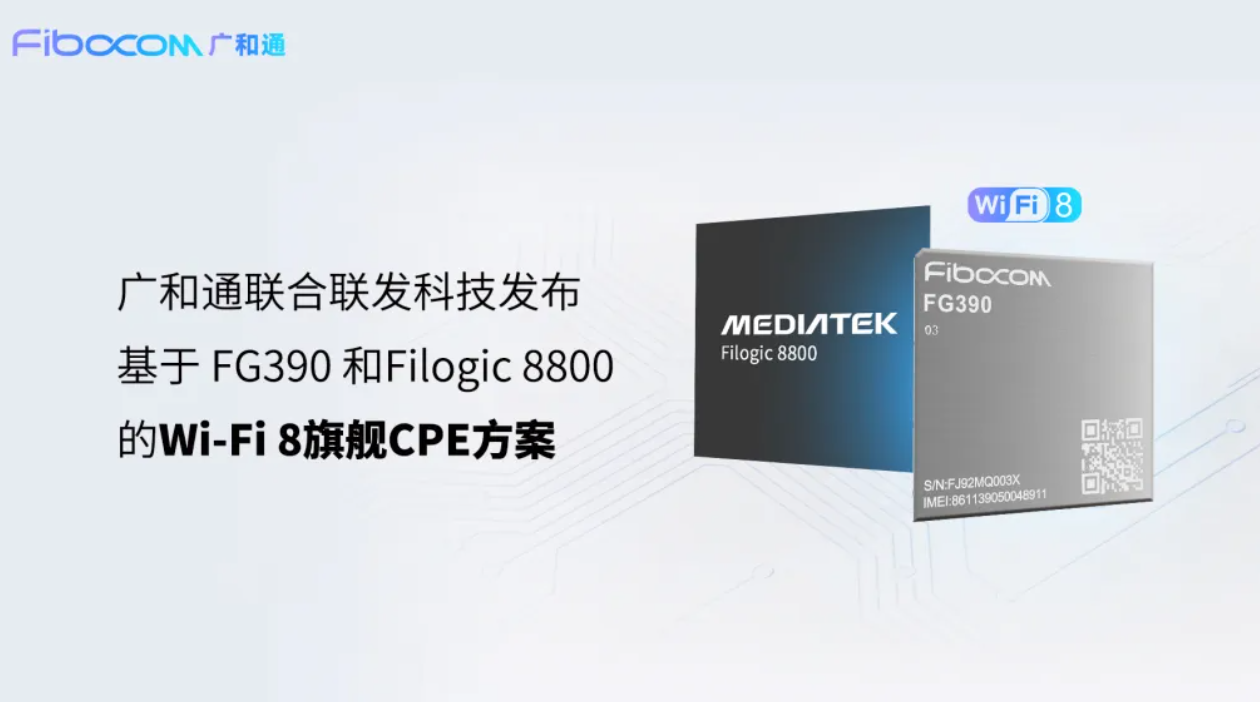
On May 19, Fibocom, a global leader in wireless communication modules and AI solutions, unveiled its pioneering FG390 series 5G module based on the MediaTek T930 platform. Designed for MBB terminal products represented by 5G Fixed Wireless Access (FWA), the FG390 series will accelerate FWA industry development in application scenarios including CPE, ODU, MiFi, enterprise gateways, and industrial gateways through advanced wireless communication technologies.

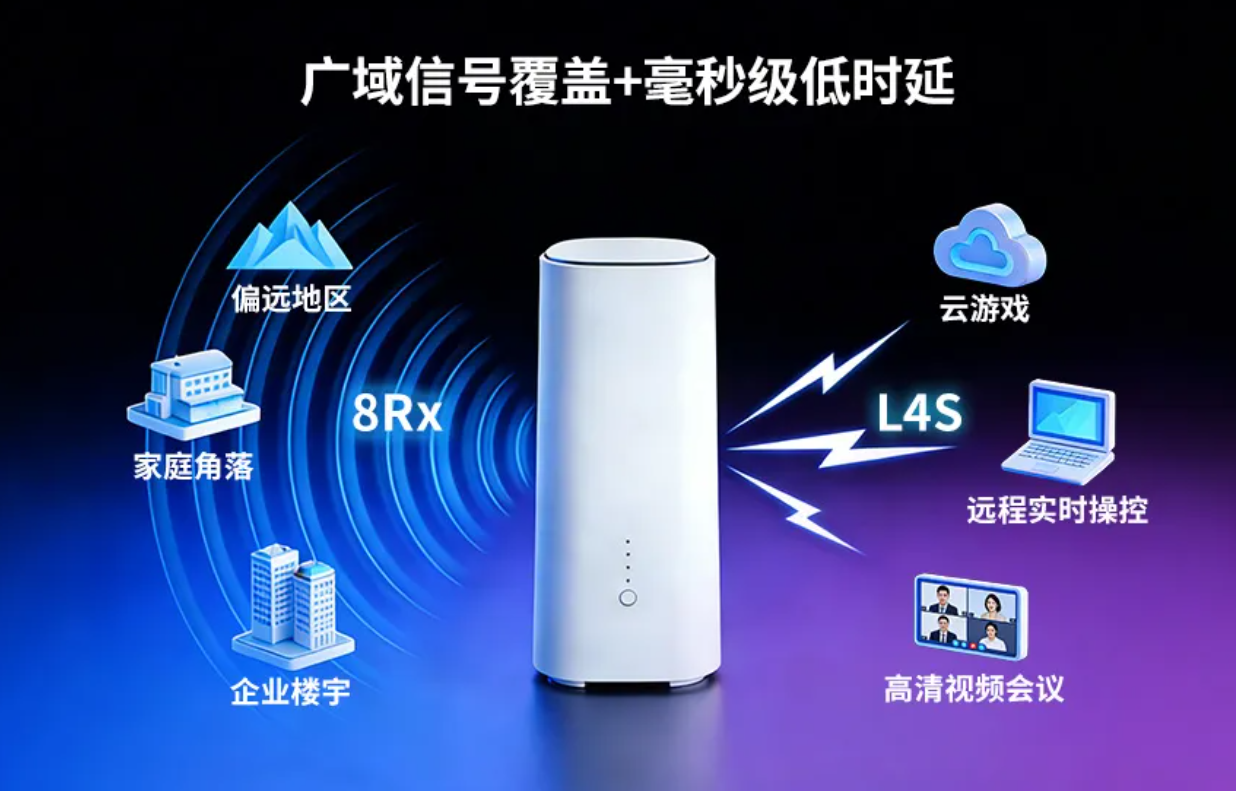
The Fibocom FG390 is a highly integrated and high-performance 5G module. Equipped with the cutting-edge MediaTek T930 chip platform manufactured using 4nm process technology, it integrates the MediaTek M90 5G modem and a quad-core ARM Cortex-A55 CPU while offering comprehensive functionalities and configurations. Supporting 3GPP Release-18 standards, it enables 6-component carrier aggregation (6CC CA) in Sub-6GHz 5G NR downlink and 5-layer 3Tx transmission in uplink, achieving maximum SA downlink speeds of 10Gbps and uplink speeds of 2.8Gbps for exceptional 5G performance. Additionally, the Fibocom FG390 incorporates 8Rx technology with 200MHz bandwidth, effectively improving spectrum efficiency by 40% at cell edges and significantly expanding signal coverage. The module can also be paired with dedicated NPU chips to create AI-powered gateway devices, delivering advanced network interaction capabilities enhanced by AI.

In this era of dual-driven 5G-Advanced and AI technology convergence, the Fibocom FG390 series will empower digital transformation across residential and enterprise scenarios through its leading technical specifications, innovative features, and rich peripheral components. This advancement will help accelerate investments and returns for operators and open markets in the communication terminal sector.

SIMCom Brings A High-Speed 5G+Wi-Fi 7 Indoor Router

In the current era of rapid AI technology development, smart devices are constantly evolving, and seamless, high-speed connectivity has become a key element in driving the development of next-generation applications. At the MWC25 World Mobile Communications Conference and the 2025 Embedded Exhibition in Germany, SIMCom  teamed up with industry-leading company Luxshare Precision to jointly showcase the 5G indoor CPE BE17000 Wi-Fi 7 Mesh Router, which significantly enhances smart terminal connectivity performance through cutting-edge 5G technology.

Relying on Luxshare Precision’s product development and manufacturing capabilities and SIMCom’s technological accumulation in communication modules, the collaboration provides high-performance, highly reliable wireless communication solutions for smart offices, industrial internet, commercial complexes, and other scenarios, promoting the large-scale application of 5G and Wi-Fi 7 technologies in vertical industries.

Technological Synergy: The Integration of 5G+Wi-Fi 7 Advantages

This 5G + WiFi 7 router integrates the SIMCom SIM8262E-M2 module, which enables 5G network capabilities simply by inserting a SIM card. With Wi-Fi 7 Mesh technology, it allows 5G networks to be shared among multiple Wi-Fi devices, achieving significant improvements in network coverage, transmission speed, and overall capacity.

5G Technology Advantages:

Based on Qualcomm’s Snapdragon X62 5G modem, it supports the main global 5G frequency bands. Whether in the Sub-6GHz or millimeter-wave frequency bands, it ensures stable transmission, meeting the communication needs of diverse scenarios.

Wi-Fi 7 Mesh Features:

By utilizing dynamic narrowband technology and multi-link aggregation, it optimizes network coverage and interference resistance. The 320MHz channel and 4K QAM technology provide high-speed transmission capabilities, supporting applications such as high-definition video playback, efficient file downloads, and smooth video conferencing.

The SIMCOM SIM8262E-M2 is a multi-band 5G NR/LTE-FDD/LTE-TDD/HSPA+ module that supports R16 5G NSA/SA, with a transmission speed of up to 2.4Gbps. It has strong expandability with rich interfaces, including PCIe, USB3.1, GPIO, and more. It is compatible with terminal devices requiring high module dimensions and network speed, such as laptops, drones, industrial tablets, MiFi, dongles, DTUs, and AR/VR headsets.

Scenario Adaptability: Unlocking Application Value Across Multiple Fields

The 5G indoor CPE BE17000 Wi-Fi 7 Mesh Router, with its reliable performance, is suitable for various scenarios:

  • Commercial Office Scenarios: It builds a stable office network environment for enterprises, supporting the needs of multiple people working online simultaneously, video conferencing, and enhancing collaboration efficiency.
  • Home Use Scenarios: It meets the multi-device networking needs within homes, providing a smooth experience for audiovisual entertainment and smart home device integration.
  • Industrial Application Scenarios: In industrial parks, warehouses, logistics, and other environments, it ensures stable data transmission, supporting remote management and monitoring of smart devices, and promoting the development of industrial internet applications.

With the continuous expansion of AI applications, high-speed, stable, and adaptive connectivity will play a crucial role in various industries, opening new development opportunities for intelligent manufacturing, smart healthcare, smart cities, and more. SIMCom will continue to increase R&D investment, drive technological innovation, and work with partners to build an interconnected smart world.

SIMCOM AI 5G 6G Products in MWC 2025

AI
At this year’s MWC, Artificial Intelligence (AI) was undoubtedly the brightest star. With the explosion of generative AI technology, more and more companies are starting to apply it across various fields. From intelligent customer service to autonomous driving, from content creation to office collaboration, AI is gradually permeating every aspect of our lives. Especially in the fields of consumer electronics and payments, the integration of AI technology has made devices such as smartphones, PCs, smart glasses, smart payment systems, and smart toys more intelligent and personalized.

SIMCOM participated in this year’s MWC by showcasing a series of products, such as the high-performance smart module SIM9650L and the 4G smart module SIM8965. These modules integrate cutting-edge AI algorithms and hardware design, providing powerful computing and data processing capabilities, thus driving the intelligent upgrade of smart terminal devices.

SIMCOM also made its debut by launching the SIMCom AI Stack, a full-stack AI solution based on its AIoT module matrix, aimed at helping customers address the pain points in the practical application of AI on the edge. This solution helps to build a complete and efficient value chain for edge-side AI.

In the future, SIMCOM will soon introduce more high-performance smart modules, working with global partners to accelerate the implementation of edge-side AI applications.

5G

As the upgraded version of 5G technology, 5G-Advanced (5G-A) also attracted significant attention at this year’s MWC. 5G-A not only improves network performance but more importantly, it begins to deeply integrate with various industries, driving digital transformation across sectors.

At the exhibition, several telecom operators showcased practical use cases of 5G-A technology in fields such as industrial IoT, low-altitude economy, and remote healthcare. Major telecommunications equipment manufacturers also demonstrated end-to-end solutions and industry application cases based on 5G-A technology, gradually bringing 5G-A technology to life.

SIMCOM has also strategically entered the 5G-A field early on. The SIMCOM SIM8390, an upgraded version of 5G, supports Sub-6GHz and mmWave frequency bands, offering higher speeds, lower latency, greater connection scale, and lower energy consumption. It has become favored by industry customers in high-speed applications and premium markets in Europe.

SIMCOM’s 5G-A strategy focuses not only on technological upgrades but also on industry adaptability. By collaborating with operators and equipment manufacturers, SIMCOM offers end-to-end solutions that help customers quickly integrate the full chain from network deployment to application, acting as an “accelerator” for enterprise digital transformation.

6G

At this year’s MWC, many companies showcased their latest research results and future plans regarding 6G technology.

Currently, 6G technology is expected to be fully commercialized around 2030, with transmission rates potentially reaching 1Tbps, far exceeding current 5G capabilities. Additionally, 6G will support AI-native networks, holographic communication, low Earth orbit satellite networks, and other advanced technologies, driving the arrival of the Internet of Everything era. In the consumer electronics sector, the introduction of 6G technology will empower smart terminal devices with higher performance and richer functionalities.

Although the commercialization of 6G is still some years away, SIMCOM has already laid the groundwork for its technological advancement. In 2023, the company launched the SIM7070G-HP-S, a satellite communication module supporting 3GPP NTN (Non-Terrestrial Networks). This module supports 3GPP Rel-17 (IoT-NTN) satellite communications in the L-band (B255) and S-band (B256/B23) frequency ranges. It also supports Cat-M/Cat-NB2 wireless communication modes and can be applied in maritime, transportation, agriculture, and energy sectors, contributing to the promotion and implementation of satellite IoT applications.

This year’s MWC 2025 highlighted three cutting-edge technologies: AI, 5G-A, and 6G, showcasing the latest trends and innovative achievements in the global telecommunications industry. As a pioneer in the global IoT communication module industry, SIMCOM actively participated and demonstrated its strong capabilities and forward-thinking vision in the field of communication technology. As these technologies continue to develop and be applied, we will usher in a more intelligent, digital, and interconnected future.

Quectel 5G RedCap Module RG255C-GL Passes Certification from Two Major North American Operators

Recently, Quectel’s 5G RedCap module RG255C-GL achieved another milestone by successfully passing the certification from two major North American operators. This certification marks that the module now fully meets the high standards of North American carriers, offering more efficient and reliable RedCap connectivity to local users, further strengthening Quectel’s competitive edge in the global IoT market.

Technological Innovation: Lightweight 5G Empowering Vertical Industries

The Quectel RG255C-GL module is based on the Qualcomm® Snapdragon® X35 platform and is equipped with 5G RedCap technology, specifically designed for high-speed IoT scenarios. As a lightweight 5G technology defined by the 3GPP R17 standard, RedCap reduces the number of terminal antennas, lowers modulation complexity, and decreases bandwidth requirements. While retaining key 5G benefits like low latency, high reliability, and network slicing, it significantly optimizes device cost, size, and power consumption, filling the market gap between traditional eMBB and LPWA.

This 5G Redcap module supports 5G Sub-6 Standalone (SA) mode and LTE Cat 4 networks, with peak download speeds of 223 Mbps and peak upload speeds of 123 Mbps, making it suitable for entry-level FWA applications, industrial sensors, and high-definition video transmission in mid- to high-speed IoT scenarios. It also supports key 5G features such as 5G LAN, uRLLC, and network slicing. In terms of positioning, the RG255C-GL integrates Qualcomm® IZat™ location technology, supporting global mainstream satellite positioning systems such as GPS, GLONASS, BDS, Galileo, and NavIC, providing precise location services for smart terminals.

High Integration Design: “Compact Size” Empowering “Large Scenarios”

The Quectel RG255C-GL adopts an LGA package with dimensions of 32.0 mm × 29.0 mm × 2.4 mm, making it compact in design. The Quectel 5G module’s size is consistent with and compatible with Quectel’s classic LTE Cat 4 module EG2x series, significantly reducing the hardware adjustment requirements for customers migrating from 4G to 5G, shortening development cycles, and lowering mass production costs. Additionally, the Quectel 5G module integrates a variety of interfaces, including USB 2.0, PCIe 2.0, PCM, UART, SGMII, and SPI, and can be paired with multiple Quectel antennas, helping terminal manufacturers quickly bring products to market and seize business opportunities.

Previously, the Quectel RG255C-GL had successfully obtained GCF global certification, North American FCC, IC, PTCRB certifications, European CE certification, and Australian RCM certification. With this latest certification from two major North American operators, the module will promote the large-scale deployment of 5G RedCap technology in global FWA and industrial automation scenarios. Moving forward, Quectel will continue to deepen its cooperation with global operators and industry partners, empowering the digital transformation of various industries with innovative technologies.

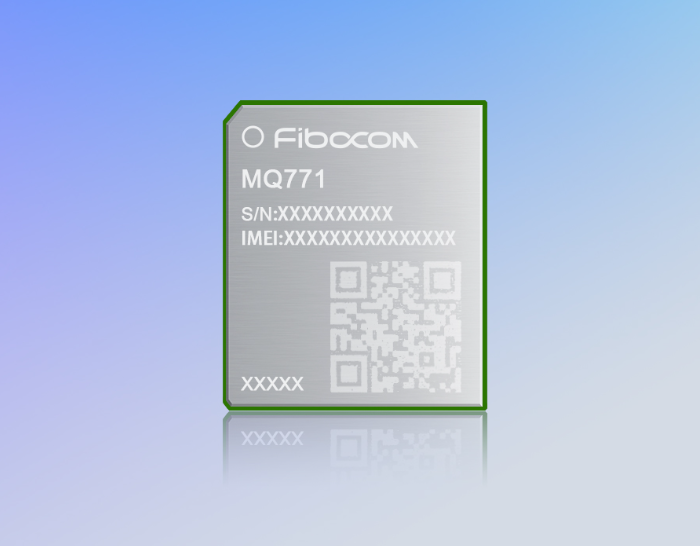
Fibocom Launches LPWA Cat.M Module MQ780-GL

On March 5, during the 2025 World Mobile Congress (MWC Barcelona 2025), Fibocom unveiled the compact Cat.M module MQ780-GL, based on the Qualcomm® E51 4G modem and RF solution. The Fibocom MQ780-GL, with its four core advantages of ultra-compact size, ultra-low power consumption, global frequency band coverage, and stable network compatibility, provides cost-effective IoT connectivity solutions for scenarios such as smart metering, asset tracking, and smart cities, accelerating the commercialization of LPWA technology on a large scale.

Dual-Mode Support, Flexible Deployment

Fibocom MQ780-GL supports 3GPP Release 14 Cat.M1 and NB-IoT standards, allowing automatic mode switching based on the network environment to maximize coverage and connection reliability. The 4G LPWA module is compatible with global mainstream frequency bands, suitable for LPWA network deployments in North America, Europe, Asia, and other regions, facilitating stable global connections.

Compact Size, Ultra-Low Power Consumption

Fibocom MQ780-GL incorporates advanced power management technology, supporting PSM (Power Saving Mode) and eDRX (extended Discontinuous Reception) functions, significantly extending the battery life of devices. In PSM mode, the standby current is as low as microampere level (μA), making it suitable for devices such as water meters and gas meters that require more than 10 years of battery life. The Fibocom 4G module adopts an LCC+LGA package design, suitable for space-constrained IoT devices.

Enhanced Performance, Rich Interfaces

Fibocom MQ780-GL supports a variety of network protocols such as MQTT/CoAP/LwM2M, and is compatible with standard interfaces such as UART/I2C/I2S, facilitating expansion to more IoT devices. In terms of positioning capabilities, the MQ780-GL has built-in Soft GPS positioning function, meeting the high-precision positioning needs of scenarios such as asset tracking. Fibocom MQ780-GL also has a built-in hardware-level security engine, supporting data encryption and security authentication, ensuring the security of device and network communication.